
How Much Sand Do I Need? Pavers, Sandboxes and More
How much sand do I need? Get the formula, the weight of dry and wet sand, and worked examples for paver bases, sandboxes, pool bases and fish tanks.
How much sand do I need? Start with volume: multiply the area in square feet by the depth in inches and divide by 324. That’s cubic yards. Then multiply by the weight of sand, which is 1.2 to 1.5 tons per cubic yard dry and 1.5 to 1.7 wet. A 20 ft by 12 ft paver patio with a 1 inch bedding layer needs 0.74 cubic yards, or about a ton.
The right depth, and even the right way to count, depends on the job. Paver bedding is a thin fixed layer. A sandbox is a deep fill bought in bags. Joint sand goes by a chart on the bag. This guide takes each job in turn, with worked numbers.
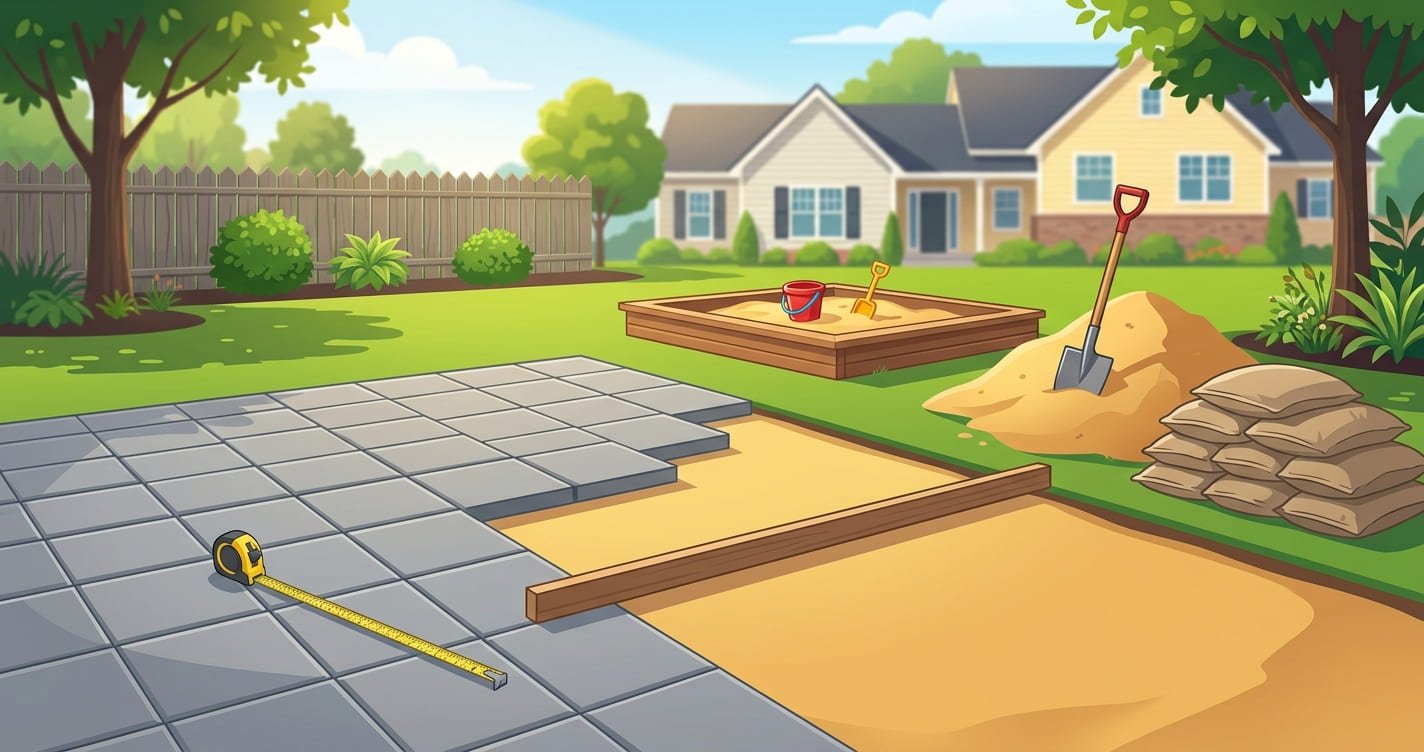
How much sand do I need? The short answer
| Question | Short answer |
|---|---|
| Volume | Square feet x depth in inches / 324 = cubic yards |
| Weight of dry sand | 1.2 to 1.5 tons per cubic yard (2,400 to 3,000 lb) |
| Weight of damp or wet sand | 1.5 to 1.7 tons per cubic yard (3,000 to 3,400 lb) |
| Under pavers | A 1 inch bedding layer |
| Bags | Sold by weight. A ton is 40 bags of 50 lb |
| One ton covers, at 1.5 tons per yard | 216 sq ft at 1 inch, 108 sq ft at 2 inches |
| Polymeric joint sand | Use the coverage chart on the bag |
Our sand calculator does the sums for several areas at once and gives tons, cubic yards, bags and cost.
How much sand do I need? The formula
cubic yards = square feet x depth (inches) / 324A cubic yard is 27 cubic feet and a foot is 12 inches, so 27 x 12 = 324. Use the shortcut and you never have to turn inches into a fraction of a foot.
tons = cubic yards x tons per cubic yardTake a 10 ft by 10 ft area, 2 inches deep. That’s 200 / 324 = 0.62 cubic yards. In dry sand it weighs 0.74 to 0.93 tons, or 1,481 to 1,852 lb.
Why the weight is a range
If you ask “how much sand do I need” in tons, the answer has two ends. Sand is usually sold by the ton, and the same pile weighs more after rain. Water fills the gaps between the grains and adds weight without adding volume.
| Sand | Tons per cubic yard | Pounds per cubic yard | Source |
|---|---|---|---|
| Dry | 1.2 to 1.5 | 2,400 to 3,000 | Caterpillar 2,400 lb. Gravelshop 2,410 lb. Omni’s density is 1.35 tons. Inch Calculator 1.3 to 1.5 |
| Damp or wet | 1.5 to 1.7 | 3,000 to 3,400 | Caterpillar 3,100 lb. Inch Calculator 1.5 to 1.7 |
From the lightest dry figure to the heaviest wet one is a gap of more than 40%. On a 5 ton order that can be a two ton difference.
What to do about it:
- Bagged sand is dry. Use the dry range.
- Bulk sand from an open pile is often damp. After rain, use the wet range.
- Best of all, ask. “How many tons to a yard for this sand today?” turns the range into one number.
If your supplier sells by the cubic yard, none of this matters for the order. The volume is the volume. Weight still matters for what your vehicle can carry.
Cubic yards by area and depth
| Area | 1 inch | 2 inches | 4 inches | 6 inches |
|---|---|---|---|---|
| 100 sq ft | 0.31 | 0.62 | 1.23 | 1.85 |
| 250 sq ft | 0.77 | 1.54 | 3.09 | 4.63 |
| 500 sq ft | 1.54 | 3.09 | 6.17 | 9.26 |
| 1,000 sq ft | 3.09 | 6.17 | 12.35 | 18.52 |
How much sand do I need under pavers?
A paver patio is built in layers: compacted soil, a compacted gravel base, a thin bed of coarse sand, then the pavers. The sand layer is the one people overdo.
The Interlocking Concrete Pavement Institute’s construction guidance gives the bedding sand as a nominal 1 inch. It’s there to seat the pavers, not to level the ground. A thicker bed lets pavers settle unevenly, so fix dips in the gravel base, not with extra sand.
At 1 inch, the sum is simple: square feet / 324 = cubic yards.
| Patio area | Cubic yards at 1 inch | Tons of dry sand |
|---|---|---|
| 100 sq ft | 0.31 | 0.37 to 0.46 |
| 200 sq ft | 0.62 | 0.74 to 0.93 |
| 300 sq ft | 0.93 | 1.11 to 1.39 |
| 400 sq ft | 1.23 | 1.48 to 1.85 |
| 500 sq ft | 1.54 | 1.85 to 2.31 |
Worked example: a 20 ft by 12 ft patio.
- Area: 20 x 12 = 240 square feet.
- Volume: 240 / 324 = 0.74 cubic yards.
- With 10% extra: 0.81 cubic yards.
- Weight in dry sand: 0.98 to 1.22 tons.
- At $45 a ton: $44 to $55.
Use coarse, washed concrete sand for bedding. Fine play sand and mason sand hold water and shift. The gravel base under the sand is a separate, much bigger order. Our rock calculator works that out, and the guide on how much rock you need explains the method.
How much sand do I need for paver joints?
Once the pavers are down, sand is swept into the joints. You can use plain fine sand or polymeric sand, which hardens when wetted and resists weeds and washout.
Don’t work joint sand out by volume. The amount depends on the joint width, the paver thickness and the paver size, so manufacturers print coverage on the bag. Two examples from product listings:
- Alliance Gator Maxx G2: a 50 lb bag covers 65 to 85 square feet with narrow joints (1/8 to 3/8 inch) and 22 to 42 square feet with wide joints.
- Sakrete Paver Polymeric Sand: a 40 lb bag covers 56 square feet at a 1/4 inch joint.
For the 240 square foot patio with narrow joints, the Gator figures give 240 / 85 = 2.8 up to 240 / 65 = 3.7. Buy 4 bags. With wide joints it’s 6 to 11 bags. Always read the chart for the product in your hand.
How much sand do I need for a sandbox?
Measure the inside of the frame and decide the depth of sand. Leave a few inches of board above the sand so it stays in the box.
Sandbox sand is bought in bags, and bags are labeled by weight. So work out the pounds, then divide by the bag weight and round up. Here are common sizes filled 6 inches deep, in 50 lb bags of dry play sand:
| Sandbox | Cubic yards | Pounds | 50 lb bags |
|---|---|---|---|
| 4 ft x 4 ft | 0.30 | 711 to 889 | 15 to 18 |
| 5 ft x 5 ft | 0.46 | 1,111 to 1,389 | 23 to 28 |
| 6 ft x 6 ft | 0.67 | 1,600 to 2,000 | 32 to 40 |
| 8 ft x 8 ft | 1.19 | 2,844 to 3,556 | 57 to 72 |
Buy toward the low end first. You can always add a few bags, and a sandbox that’s slightly under-filled spills less.
For the 8 ft box, bulk delivery is worth a call. Sixty bags is a lot of lifting. Ask for washed play sand.
How much sand do I need under a pool?
Sand is often used as a cushion under an above-ground pool liner. The depth is the pool maker’s call. Instructions differ, and some forbid sand under the frame or uprights. Read them first.
Worked example: a 15 ft round pool with a 2 inch layer.
- Radius: 7.5 ft. Area: 3.1416 x 7.5 x 7.5 = 176.7 square feet.
- Volume: 176.7 x 2 / 324 = 1.09 cubic yards.
- Weight, not knowing how wet the sand is: 1.31 to 1.85 tons.
When the pool is full, the pool salt calculator covers the water side for a salt system.
How much sand do I need for an aquarium?
The same formula works for a fish tank. It’s just smaller. Convert the footprint from inches to feet by dividing by 12, or work in cubic inches.
Worked example: a 48 inch by 13 inch footprint with 2 inches of sand.
- Volume: 48 x 13 x 2 = 1,248 cubic inches.
- In cubic feet: 1,248 / 1,728 = 0.72.
- Weight in dry sand: 64 to 80 lb.
Aquarium substrates vary more than builder’s sand. Some are lighter, and some aren’t sand at all. If the bag gives a weight per volume, use that. Treat the figure above as a starting point for ordinary silica sand, and buy the smaller amount first.
How much sand do I need for filling and leveling?
For filling a low area, backfilling a trench or leveling under a shed base, use the formula with the real depth. Measure the depth in several places and average it.
Sand packs down when it’s tamped. Gravelshop adds 15% to its fill sand estimates for compression. A large fill shows why weight matters: an area 60 ft by 30 ft filled 12 inches deep is 66.67 cubic yards, which is 80 to 100 tons of dry sand. The gap between the low and the high figure is 20 tons, so get the supplier’s weight before ordering.
How much area a ton of sand covers
| Depth | Light, dry sand (1.2) | Middle (1.5) | Wet sand (1.7) |
|---|---|---|---|
| 1 inch | 270 sq ft | 216 sq ft | 191 sq ft |
| 2 inches | 135 sq ft | 108 sq ft | 95 sq ft |
| 3 inches | 90 sq ft | 72 sq ft | 64 sq ft |
| 4 inches | 68 sq ft | 54 sq ft | 48 sq ft |
| 6 inches | 45 sq ft | 36 sq ft | 32 sq ft |
To use it, divide your square footage by the figure for your depth. A 432 square foot area at 2 inches needs 432 / 108 = 4 tons at 1.5 tons per yard.
Bags or bulk?
For a small job, “how much sand do I need” really means “how many bags”. A ton is 50 bags of 40 lb, 40 bags of 50 lb, or 34 bags of 60 lb.
- Bags suit small jobs: a fish tank, a small sandbox, sweeping joints. They’re dry, clean and fit through a gate.
- Bulk suits anything near a ton or more.
Prices vary by region, so compare for yourself. Multiply the price of one bag by the number of bags in a ton, and set that against the delivered price per ton from a local yard, including the delivery fee.
If you plan to collect bulk sand yourself, check your vehicle. A cubic yard of sand is 2,400 to 3,400 lb, which is more than many pickup trucks are rated to carry. The payload figure is on the sticker inside the driver’s door.
Which sand for which job
| Job | Sand usually used |
|---|---|
| Paver bedding | Coarse, washed concrete sand |
| Paver joints | Polymeric sand or fine joint sand |
| Mortar and brickwork | Mason sand, which is finer |
| Sandboxes | Washed play sand |
| Filling and leveling | Fill sand |
The type matters as much as the amount. Before “how much sand do I need” comes “which sand”. Names change from region to region. Tell the supplier what the sand is for and let them match the product.
Common mistakes
- Making the paver bed too deep. One inch. More causes settling.
- Using play sand under pavers. It’s too fine.
- Treating a cubic yard as a ton. A yard of sand is 1.2 to 1.7 tons.
- Using a dry weight for a wet pile. You’ll get less volume than you planned for the tons you paid for.
- Working out joint sand by volume. Use the chart on the bag.
- Counting sand bags by cubic feet. They’re labeled in pounds.
- Measuring the outside of a sandbox. The boards take up room.
What to ask the supplier
A two minute call settles most of what this guide can only give as a range. Have your cubic yards ready, tell them the job, and ask:
- Do you sell by the ton or by the cubic yard?
- How many tons to a yard for this sand right now?
- Is it washed?
- What’s the minimum order and the delivery fee?
- Where can the truck tip?
Rounding the order
Bulk suppliers sell in set amounts, so your figure will need rounding. Round up, not down. A little spare sand is useful: it tops up the joints after the first rain, fills the low spot you find later, or refreshes a sandbox next spring. Running short is worse, because a second delivery means a second delivery fee.
If you worked from the dry range and the yard’s pile is wet, order toward the top of your tons. If you’re buying bags, start at the low count and keep the receipt, since unopened bags are easy to take back or keep dry in a shed.
Other materials for the same job
For soil you’re bringing in or digging out, the dirt calculator handles swell and truckloads. For lawns and beds there’s the topsoil calculator. For concrete or mulch by volume alone, use the cubic yard calculator.
Frequently asked questions
1. How much sand do I need for a 10×10 paver patio?
At a 1 inch bedding layer, 100 / 324 = 0.31 cubic yards. In dry sand that’s 0.37 to 0.46 tons, or about 740 to 930 lb. Add 10% for waste.
2. How much sand do I need for a 4×4 sandbox?
Filled 6 inches deep, 0.30 cubic yards, which is 711 to 889 lb of dry sand. That’s 15 to 18 bags of 50 lb.
3. How much does a cubic yard of sand weigh?
Dry sand weighs 2,400 to 3,000 lb per cubic yard. Damp or wet sand weighs 3,000 to 3,400 lb.
4. How many bags of sand are in a ton?
Fifty bags of 40 lb, 40 bags of 50 lb, or 34 bags of 60 lb.
5. How thick should the sand be under pavers?
A nominal 1 inch, according to the Interlocking Concrete Pavement Institute’s construction guidance. It’s a setting bed, not a leveling layer.
6. How much polymeric sand do I need?
It depends on the joint width and the product. As one example, a 50 lb bag of Gator Maxx G2 covers 65 to 85 square feet with narrow joints. Check the chart on your bag.
7. How much area does a ton of sand cover?
At 1.5 tons per cubic yard, 216 square feet at 1 inch deep and 108 at 2 inches. Dry, lighter sand covers more.
8. Is sand sold by the ton or by the yard?
Both. Ask your supplier. If it’s by the ton, ask for their tons per cubic yard so your volume converts to their scale.
9. Does wet sand change how much I need?
It doesn’t change the volume. It changes the weight. If you buy by the ton, a wet pile gives you fewer cubic yards per ton, so you need more tons to fill the same space.
10. Can I use play sand under pavers?
It isn’t recommended. Play sand is finer than bedding sand, so it holds water and shifts. Coarse, washed concrete sand is the usual bedding material.
Work out your order
You can answer “how much sand do I need” with a tape measure and the 324 shortcut. For several areas, a bag count by weight or a quick cost, the sand calculator does it in one pass and shows the working. It runs in your browser and stores nothing. More calculators are on the home and garden tools page.
Sources
- Caterpillar, “Material Density Tables to Help Estimate Earthwork Volumes”: dry and wet sand weights.
- Gravelshop fill sand calculator: 2,410 lb per cubic yard and the 15% compression allowance.
- Omni Calculator and Inch Calculator sand calculators: densities for dry and wet sand.
- Interlocking Concrete Pavement Institute construction guidance: nominal 1 inch bedding sand.
- Alliance Gator Maxx G2 technical data and the Sakrete Paver Polymeric Sand listing: coverage per bag.
Tools in this guide
Sand Calculator
Tons, cubic yards and bags of sand, with the weight shown as a dry-to-wet range.
Rock Calculator
Tons and cubic yards of landscape rock, with an honest range for the weight.
Dirt Calculator
Cubic yards, tons and truckloads of dirt, whether you are filling in or digging out.
Topsoil Calculator
Cubic yards and bags of topsoil for lawns and beds, with a mix split and a bulk or bags check.
Cubic Yard Calculator
Cubic yards for several areas of any shape, with extra for waste, bags and cost.
Pool Salt Calculator
How much salt your pool needs, and how many bags to buy.
All of them run in your browser. Nothing uploaded.
More guides
Home & Garden
How Much Rock Do I Need? Formula, Charts and Examples
How much rock do I need? Square feet x inches / 324 gives cubic yards, then multiply by tons per yard. Charts, depths, coverage and worked examples.
Tool: Rock Calculator
Home & Garden
How Much Dirt Do I Need? Formula, Chart and Examples
How much dirt do I need? Use square feet x inches / 324 for cubic yards, then add for settling. Charts, weights, bags and worked examples inside.
Tool: Dirt Calculator
Home & Garden
How Much Salt to Add to Pool Water: Formula and Charts
Work out how much salt to add to pool water with one formula. Charts by pool size, targets for Hayward, Jandy and Pentair, and how to fix too much.
Tool: Pool Salt Calculator
Last updated: October 7, 2026