
How Much Rock Do I Need? Formula, Charts and Examples
How much rock do I need? Square feet x inches / 324 gives cubic yards, then multiply by tons per yard. Charts, depths, coverage and worked examples.
How much rock do I need? Two sums answer it. Multiply the area in square feet by the depth in inches and divide by 324 to get cubic yards. Then multiply by the weight of your rock in tons per cubic yard. A 10 ft by 10 ft bed covered 3 inches deep is 0.93 cubic yards, which is 1.02 to 1.62 tons of river rock.
That answer is a range, and that’s the honest part. Rock is sold by the ton, and a cubic yard of it doesn’t weigh the same from one quarry to the next. This guide shows how to measure, how deep to go, what each rock weighs, and how to turn the range into one number before you order.
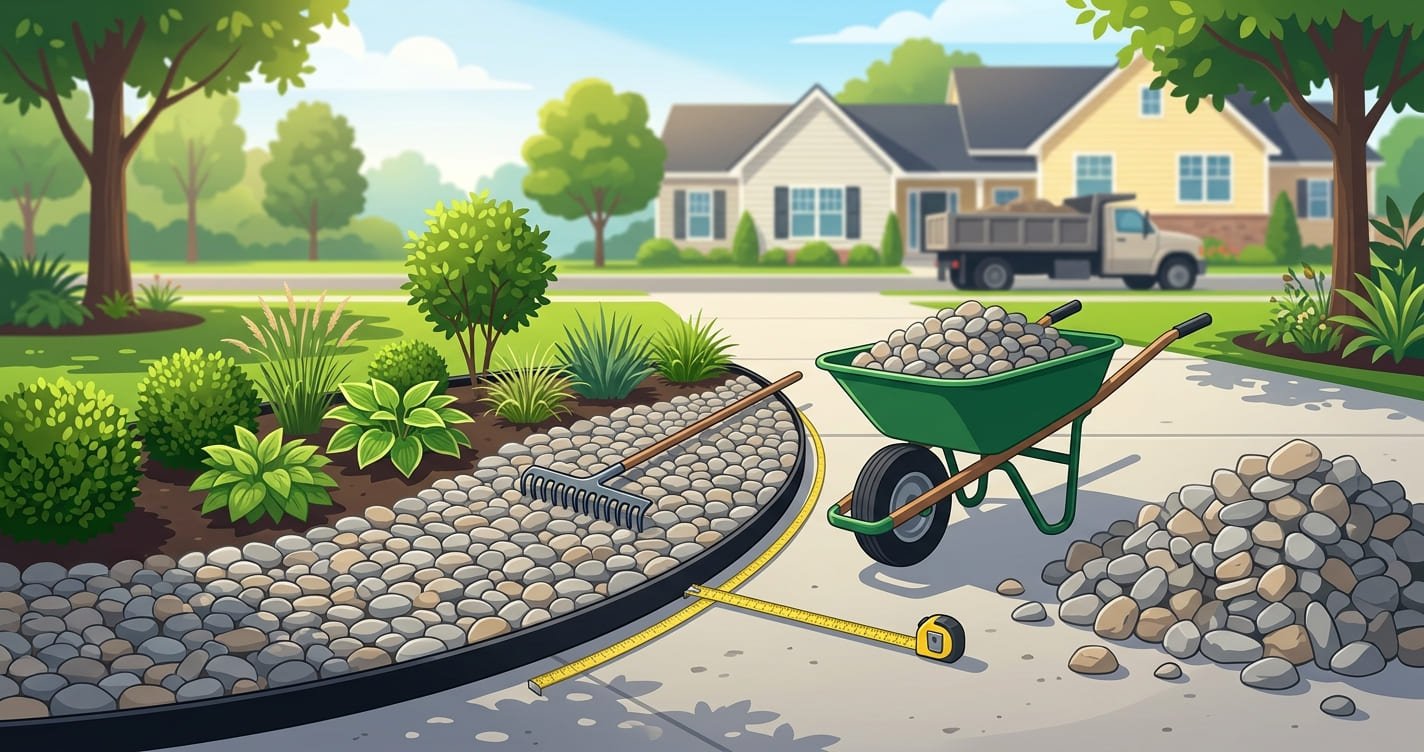
How much rock do I need? The short answer
| Question | Short answer |
|---|---|
| Volume | Square feet x depth in inches / 324 = cubic yards |
| Weight | Cubic yards x tons per cubic yard = tons |
| River rock | 1.1 to 1.75 tons per cubic yard |
| Pea gravel | 1.4 to 1.6 tons per cubic yard |
| Crushed stone or gravel | 1.35 to 1.7 tons per cubic yard |
| Usual depth for decorative rock | 2 to 4 inches |
| One ton covers, at 1.35 tons per yard | 120 sq ft at 2 inches, 80 sq ft at 3 inches, 60 sq ft at 4 inches |
| Extra to add | About 10% |
Our rock calculator does both sums for up to 20 areas at once, each with its own rock, shape and depth, and gives tons, cubic yards, bags and cost.
How much rock do I need? The two sums
Sum 1: volume
cubic yards = square feet x depth (inches) / 324A cubic yard is 27 cubic feet, and a foot is 12 inches. 27 x 12 = 324. Using 324 means you never have to turn inches into a fraction of a foot, which is where most hand calculations go wrong.
Sum 2: weight
tons = cubic yards x tons per cubic yardThe second number depends on the rock. We’ll come back to it, because it’s the part that decides whether you order enough.
A first example
A bed is 10 ft by 10 ft and you want 3 inches of river rock.
- Area: 10 x 10 = 100 square feet.
- Volume: 100 x 3 / 324 = 0.93 cubic yards.
- Lightest published weight: 0.93 x 1.1 = 1.02 tons.
- Heaviest published weight: 0.93 x 1.75 = 1.62 tons.
So you need 1.02 to 1.62 tons, with 1.32 in the middle.
Step 1: measure the area
Any answer to “how much rock do I need” is only as good as the tape measure. Split the job into simple shapes and add them up.
| Shape | Area | Typical use |
|---|---|---|
| Rectangle | Length x width | Beds, paths, driveways |
| Circle | 3.1416 x radius x radius | Seating areas, round beds |
| Triangle | Base x height / 2 | Corner beds |
| Ring | Outer circle minus inner circle | Rock around a tree or a fire pit |
A few habits save a second trip:
- Split odd shapes. An L-shaped bed is two rectangles. A bed with a rounded end is a rectangle plus half a circle.
- Turn inches into decimals. 10 ft 6 in is 10.5 ft.
- Leave out what you won’t cover. Stepping stones, planters and tree trunks take up space the rock doesn’t fill.
- Use the full width for a circle, then halve it for the radius. Mixing the two up gives a quarter of the rock, or four times too much.
Step 2: choose the depth
Ask a supplier “how much rock do I need” and their first question back is “how deep?”. Depth changes the order as much as area does. Going from 2 inches to 4 inches doubles it.
| Job | Depth | Source |
|---|---|---|
| Decorative beds | 2 to 4 inches | Inch Calculator: most landscaping projects use 2 to 4 inches |
| Pea gravel and river rock | At least 2 inches | Stone Center of Ohio |
| Paths and driveways | 4 to 6 inches of crushed stone is a common base | Common supplier recommendation |
| Drainage and wall backfill | Often 8 to 12 inches | Follow the plan for the job |
One rule comes from geometry, not from a supplier: the layer has to be at least as deep as the stones are big. You can’t spread 3 inch stones 2 inches deep. For full coverage with no ground showing, plan a layer a bit deeper than the largest stone.
If you’re topping up an old bed, measure only the missing depth. An inch of fresh rock over a tired bed is a third of the order a new 3 inch bed needs.
Cubic yards by area and depth
Before weight comes into it, here’s the volume for common areas.
| Area | 2 inches | 3 inches | 4 inches |
|---|---|---|---|
| 100 sq ft | 0.62 | 0.93 | 1.23 |
| 250 sq ft | 1.54 | 2.31 | 3.09 |
| 500 sq ft | 3.09 | 4.63 | 6.17 |
| 1,000 sq ft | 6.17 | 9.26 | 12.35 |
If your supplier sells by the cubic yard, you can stop here. Add your extra and place the order. If they sell by the ton, keep going.
Step 3: what a cubic yard of rock weighs
This is where “how much rock do I need” stops being simple. We checked the weights that suppliers and other calculators publish, and they don’t agree.
| Rock | Tons per cubic yard | Where the figures come from |
|---|---|---|
| River rock | 1.1 to 1.75 | Inch Calculator gives 1.1 to 1.4. Stone Center of Ohio gives 1.4 to 1.75. Omni’s density works out to 1.20 |
| Pea gravel | 1.4 to 1.6 | Stone Center of Ohio. Omni’s density works out to 1.51 |
| Crushed stone or gravel | 1.35 to 1.7 | Stone Center of Ohio. Inch Calculator gives 1.4 to 1.7. Omni’s works out to 1.35 |
| Decorative landscape rock | 1.25 to 1.35 | Southwest Boulder & Stone uses 1.25. Bedrock Landscaping Materials’ chart works out to 1.35 |
For river rock, the heaviest figure is 59% above the lightest. Three things cause the spread:
- The stone itself. Granite, limestone and sandstone have different densities.
- Size and shape. Round stones leave more air between them than angular crushed stone that locks together.
- Water. Rock delivered wet weighs more, and you pay for the water when it’s sold by the ton.
None of those figures is wrong. Each describes one supplier’s product. So the number that settles it is the one from the yard you’re buying from. Ask them: “How many tons to a yard for this rock?”
Here’s the same 100 square foot bed at 3 inches in each rock:
| Rock | Cubic yards | Tons |
|---|---|---|
| River rock | 0.93 | 1.02 to 1.62 |
| Pea gravel | 0.93 | 1.30 to 1.48 |
| Crushed stone or gravel | 0.93 | 1.25 to 1.57 |
| Decorative landscape rock | 0.93 | 1.16 to 1.25 |
How much area one ton covers
Some suppliers answer “how much rock do I need” in coverage: “a ton does about 80 square feet.” That’s the same formula turned around. Square feet per ton = 324 / depth in inches / tons per cubic yard.
| Depth | Light rock (1.1) | 1.35 | 1.5 | Heavy rock (1.75) |
|---|---|---|---|---|
| 1 inch | 295 sq ft | 240 sq ft | 216 sq ft | 185 sq ft |
| 2 inches | 147 sq ft | 120 sq ft | 108 sq ft | 93 sq ft |
| 3 inches | 98 sq ft | 80 sq ft | 72 sq ft | 62 sq ft |
| 4 inches | 74 sq ft | 60 sq ft | 54 sq ft | 46 sq ft |
| 6 inches | 49 sq ft | 40 sq ft | 36 sq ft | 31 sq ft |
The 1.35 column matches the chart Bedrock Landscaping Materials publishes for its rock: 240, 120, 80, 60 and 40 square feet per ton. To use coverage, divide your square footage by the figure for your depth. A 400 square foot bed at 3 inches needs 400 / 80 = 5 tons at 1.35.
How much rock do I need? Worked examples
A ring of pea gravel around a fire pit
The gravel area is 14 ft across, with a 4 ft fire pit in the middle. You want 3 inches of pea gravel.
- Outer circle: 3.1416 x 7 x 7 = 153.9 square feet.
- Inner circle: 3.1416 x 2 x 2 = 12.6 square feet.
- Ring: 141.4 square feet.
- Volume: 141.4 x 3 / 324 = 1.31 cubic yards.
- Weight: 1.31 x 1.4 to 1.6 = 1.83 to 2.09 tons.
Order 2 tons. The range is narrow because published weights for pea gravel agree closely.
River rock around a tree
A ring 6 ft across with a 2 ft gap for the trunk, 3 inches deep.
- Area: 3.1416 x (3 x 3 – 1 x 1) = 25.1 square feet.
- Volume: 25.1 x 3 / 324 = 0.23 cubic yards, which is 6.3 cubic feet.
- Weight: 0.26 to 0.41 tons.
That’s a bag job. In bags of 0.5 cubic feet, you need 13.
A dry creek bed
A winding bed about 30 ft long and 3 ft wide, with 4 inches of river rock.
- Area: 30 x 3 = 90 square feet.
- Volume: 90 x 4 / 324 = 1.11 cubic yards.
- Weight: 1.22 to 1.94 tons.
The spread here is nearly three quarters of a ton. Get the supplier’s figure before ordering.
A gravel driveway, with a supplier’s figure
A driveway is 40 ft by 12 ft at 4 inches deep: 480 x 4 / 324 = 5.93 cubic yards. The quarry says their driveway gravel weighs 1.4 tons per cubic yard. 5.93 x 1.4 = 8.30 tons. At $45 a ton, that’s $373.33 before delivery. One figure from the supplier turned a range into an exact order.
Three areas in one order
A front yard has a river rock border, a round pea gravel seating area and a crushed stone path. You add 10% for waste.
| Area | Rock | Cubic yards, with 10% | Tons |
|---|---|---|---|
| Border, 20 ft x 6 ft at 3 inches | River rock | 1.22 | 1.34 to 2.14 |
| Circle, 12 ft across at 2 inches | Pea gravel | 0.77 | 1.08 to 1.23 |
| Path, 30 ft x 10 ft at 4 inches | Crushed stone | 4.07 | 5.50 to 6.93 |
| Total | 6.06 | 7.92 to 10.29 |
At $65 a ton, that’s $514.77 to $669.08 before delivery. The spread is more than two tons. On an order this size, a phone call for each rock’s weight pays for itself.
Step 4: add extra
The honest answer to “how much rock do I need” is always a little more than the sum says. Ground isn’t level, edges aren’t straight, and rock settles into soft soil. Stone Center of Ohio builds a standard 10% into its own calculator. Bedrock Landscaping Materials recommends adding 10% by weight for road base and similar material that gets compacted.
On firm ground over landscape fabric, you’ll need less. On loose or uneven soil, more. Ten percent is a sensible default.
Large rock is different
For boulders and cobbles, “how much rock do I need” has a different method. The depth sum works for rock you can rake. Cobbles and bigger stones are laid one layer thick, so suppliers quote coverage per ton instead. Bedrock Landscaping Materials lists about 60 square feet per ton for 2 to 4 inch rock and 40 square feet per ton for 4 to 8 inch rock.
For stone that size, ask your supplier for their coverage figure and divide your square footage by it. A 240 square foot area in 2 to 4 inch rock would be 240 / 60 = 4 tons on Bedrock’s figure.
How much rock do I need in tons, yards or bags?
- Sold by the cubic yard. Use the volume. Weight only matters for the truck.
- Sold by the ton. You need the conversion. Ask for it.
- Sold in bags. Bagged rock is usually 0.5 cubic feet. It takes 54 of those to make a cubic yard, so bags suit small jobs only.
If you have one quote per ton and another per yard, convert them to the same unit before comparing. At 1.4 tons per yard, $45 a ton is $63 a yard.
Order toward the top or the bottom of the range?
When you can’t get a supplier figure, “how much rock do I need” stays a range, and you have to choose where in the range to order. Think about what a shortfall costs.
- Order toward the top if a second delivery carries its own fee, or if the rock is a specific color you might not match later.
- Order toward the bottom if you can easily collect a top-up yourself and don’t want a leftover pile.
The middle of the range is fine for a first budget. It’s not a good figure for the final order.
Before the truck arrives
- Decide where it tips. A loaded truck is heavy. Many drivers will only tip on a driveway or at the curb.
- Ask about the load limit. Trucks carry a set weight, so a big order may come as two loads.
- Prepare the ground. Clear weeds, set edging, and lay landscape fabric if you’re using it. Rock is far easier to spread onto a finished bed than to work around.
- Have a wheelbarrow and a rake ready. A ton is 2,000 lb. At 100 lb a barrow load, that’s 20 trips.
Common mistakes
- Treating a cubic yard as a ton. A yard of rock weighs more than a ton. Order 5 tons for a 5 yard job and you’ll come up short.
- Leaving depth in inches in a feet formula. 10 x 10 x 3 isn’t 300 cubic feet. Three inches is a quarter of a foot.
- Using the radius as the diameter, or the other way round.
- Forgetting what’s already there. A top-up needs only the missing depth.
- Choosing a layer thinner than the stones.
- Trusting one website’s density. Including ours. A range is a planning tool until a supplier confirms it.
Other materials for the same job
Once you know how much rock you need, the rest of the list is easier. Rock is rarely the whole order. For the sand under pavers or in a sandbox, use the sand calculator. For soil you’re bringing in or hauling away, the dirt calculator handles swell and truckloads, and our guide on how much dirt you need walks through it. For mulch or concrete by volume, there’s the cubic yard calculator.
Frequently asked questions
1. How much rock do I need for 100 square feet?
At 2 inches deep, 0.62 cubic yards. At 3 inches, 0.93. At 4 inches, 1.23. In river rock at 3 inches, that’s 1.02 to 1.62 tons.
2. How much rock do I need for 1,000 square feet?
At 2 inches deep, 6.17 cubic yards. At 3 inches, 9.26. At 1.35 tons per cubic yard, those are 8.3 and 12.5 tons.
3. How many square feet does a ton of rock cover?
At 1.35 tons per cubic yard, a ton covers 120 square feet at 2 inches, 80 at 3 inches and 60 at 4 inches. Lighter rock covers more and heavier rock covers less.
4. How many tons are in a cubic yard of rock?
Published figures run from 1.1 to 1.75 for river rock, 1.4 to 1.6 for pea gravel and 1.35 to 1.7 for crushed stone. Your supplier knows the figure for the product they sell.
5. How deep should landscape rock be?
Two to four inches for decorative rock, and at least 2 inches for pea gravel and river rock. The layer also needs to be at least as deep as the largest stones.
6. How much river rock do I need?
Work out the cubic yards, then multiply by 1.1 to 1.75. River rock has the widest range of any common rock, so ask the supplier for their weight before ordering by the ton.
7. How much extra rock should I order?
About 10%. Add more on loose or uneven ground, less on firm ground over fabric.
8. Is it cheaper to buy rock in bags or in bulk?
Prices vary by area, so compare directly. It takes 54 bags of 0.5 cubic feet to make a cubic yard. Multiply the bag price by 54 and set it against the delivered price per yard.
9. Should I put landscape fabric under rock?
Many installers do, to slow weeds and stop the rock sinking into the soil. It doesn’t change how much rock you need by much, though firm ground under fabric needs less extra than loose soil.
10. Why do two calculators give me different tonnages?
They use different weights per cubic yard. For river rock, published figures differ by more than half. The volume should match between tools. If it doesn’t, check the depth units.
Work out your order
You can answer “how much rock do I need” with a tape measure, the 324 shortcut and one phone call to the supplier. For several areas, mixed rock types or a quick cost, the rock calculator does it in one pass and shows the working. It runs in your browser and stores nothing. More calculators are on the home and garden tools page.
Sources
- Stone Center of Ohio, landscape rock calculator page: weights per cubic yard, minimum depths and the 10% allowance.
- Inch Calculator, river rock calculator: river rock 1.1 to 1.4 and gravel 1.4 to 1.7 tons per cubic yard; 2 to 4 inch depths.
- Omni Calculator, river rock calculator: densities for river rock, pea gravel and crushed stone.
- Southwest Boulder & Stone, coverage calculator: 1.25 tons per cubic yard rule of thumb.
- Bedrock Landscaping Materials, yardage calculator: coverage per ton by depth and for large rock; 10% for compaction.
All checked on October 2, 2026.
Tools in this guide
Rock Calculator
Tons and cubic yards of landscape rock, with an honest range for the weight.
Sand Calculator
Tons, cubic yards and bags of sand, with the weight shown as a dry-to-wet range.
Dirt Calculator
Cubic yards, tons and truckloads of dirt, whether you are filling in or digging out.
Cubic Yard Calculator
Cubic yards for several areas of any shape, with extra for waste, bags and cost.
All of them run in your browser. Nothing uploaded.
More guides
Home & Garden
How Much Sand Do I Need? Pavers, Sandboxes and More
How much sand do I need? Get the formula, the weight of dry and wet sand, and worked examples for paver bases, sandboxes, pool bases and fish tanks.
Tool: Sand Calculator
Home & Garden
How Much Dirt Do I Need? Formula, Chart and Examples
How much dirt do I need? Use square feet x inches / 324 for cubic yards, then add for settling. Charts, weights, bags and worked examples inside.
Tool: Dirt Calculator
Home & Garden
How Much Salt to Add to Pool Water: Formula and Charts
Work out how much salt to add to pool water with one formula. Charts by pool size, targets for Hayward, Jandy and Pentair, and how to fix too much.
Tool: Pool Salt Calculator
Last updated: October 7, 2026