
How Much Salt to Add to Pool Water: Formula and Charts
Work out how much salt to add to pool water with one formula. Charts by pool size, targets for Hayward, Jandy and Pentair, and how to fix too much.
Working out how much salt to add to pool water takes three numbers: the pool’s volume, the salt level now, and the level your chlorinator wants. Multiply the gallons by the rise you need in ppm, then by 8.345, and divide by a million. That’s the pounds of salt. A 15,000 gallon pool going from 2,000 to 3,200 ppm needs 150 lb, which is four 40 lb bags.
Most guides stop at a rule of thumb or a single target of 3,200 ppm. Neither is safe to rely on. The big chlorinator brands ask for levels 600 ppm apart, and a rule of thumb can overshoot by hundreds of pounds. This guide shows the exact sum, the tables, how to add the salt, and what to do if you put in too much.
How much salt to add to pool water: the short answer
| Question | Short answer |
|---|---|
| The formula | Pounds = gallons x ppm rise x 8.345 / 1,000,000 |
| Quick mental version | 0.83 lb per 1,000 gallons for every 100 ppm |
| What one 40 lb bag does | Raises 10,000 gallons by about 479 ppm |
| Target level | Jandy 3,000 ppm, Hayward 3,200, Pentair 3,600. Check your manual |
| New 10,000 gallon pool | 250 to 300 lb, depending on the brand |
| How to add it | Chlorinator off, pump on, spread it around, brush, wait 24 hours, retest |
| Added too much? | Drain part of the water and refill. Nothing else removes salt |
Our pool salt calculator does the sum for you. It fills in the target for your brand, works out the volume from measurements if you don’t know it, and gives the answer in whole bags of whatever size you buy.
Why the amount matters
A saltwater pool is still a chlorine pool. The chlorinator, also called a salt cell or salt chlorine generator, passes a current through salty water and turns part of the salt into chlorine. That chlorine sanitizes the water and then turns back into salt.
The cell is built for a narrow band of salinity. Below it, the cell can’t make enough chlorine, and most units show a low salt warning or shut down. Above it, the unit may shut down too, and very salty water is harder on metal fittings. That’s why how much salt to add to pool water is worth getting right the first time. You can add salt in minutes, but you can only take it out by draining.
For scale: pool salt levels are around 3,000 to 3,600 ppm. Seawater is about 35,000 ppm. A salt pool is roughly a tenth as salty as the ocean.
Step 1: find your target salt level
The target decides how much salt to add to pool water, and almost every guide online gives one number, 3,200 ppm, as if it applied to every pool. It doesn’t. These are the figures from three manufacturers’ own manuals:
| Salt system | Ideal | Stated range |
|---|---|---|
| Jandy TruClear | 3,000 ppm | 3,000 to 3,500 ppm |
| Hayward Aqua Trol | 3,200 ppm | 2,700 to 3,400 ppm |
| Pentair IntelliChlor | 3,600 ppm | 3,600 to 4,500 ppm |
We read those from the Hayward Aqua Trol, Jandy Pro Series TruClear and Pentair IntelliChlor IC15/20/40/60 manuals on September 22, 2026.
Look at where the ranges sit. Pentair’s minimum of 3,600 ppm is higher than the maximum for both Hayward and Jandy. Dose a Pentair pool to 3,200 ppm and you finish 400 ppm under its minimum. Dose a Hayward pool to Pentair’s ideal and you’re 200 ppm over its maximum.
Models within a brand can differ too. Find the manual for your exact unit and use the number printed there. If the manual gives a range and an ideal, aim for the ideal.
Step 2: test the current salt level
You can’t decide how much salt to add to pool water without knowing what’s already in it. Even a pool that has never had salt can read a few hundred ppm, because liquid chlorine and other pool chemicals leave salt behind.
There are three common ways to test:
- Salt test strips. Cheap and quick. Dip, wait, and read the scale. Good enough for most top-ups.
- A digital salinity meter. More precise and reusable. Rinse the probe after each use and recalibrate when the instructions say to.
- The chlorinator’s own display. Convenient, but it measures through the cell, so a scaled or ageing cell can read low. The Pool Factory advises waiting 24 to 48 hours after adding salt before you rely on the display.
If the display and a strip disagree by a lot, trust neither until you’ve checked with a third method or taken a sample to a pool shop. Adding 200 lb of salt because of one bad reading is an expensive mistake to undo.
Take the sample from elbow depth, away from the return jets, with the pump running. For a brand new pool filled with fresh water, use 0 ppm, or test the fill water if it comes from a well or a softener.
Step 3: know your pool volume
The volume is in the paperwork from your builder or on the box of an above-ground pool. If you can’t find it, measure.
| Pool shape | Volume in US gallons |
|---|---|
| Rectangle | Length x width x average depth x 7.48 |
| Round | 3.1416 x radius x radius x depth x 7.48 |
| Oval | 3.1416 x half the length x half the width x depth x 7.48 |
All measurements are in feet. Average depth is the shallow end plus the deep end, divided by two. Use the depth of the water, not the height of the wall. Most pools sit a few inches below the top.
For example, a 32 ft by 16 ft pool that slopes from 3 ft to 7 ft has an average depth of 5 ft. That’s 32 x 16 x 5 = 2,560 cubic feet, or about 19,150 gallons.
A wrong volume gives a wrong answer for how much salt to add to pool water, and for every other chemical too. It’s worth ten minutes with a tape measure.
Step 4: the formula for how much salt to add to pool water
pounds of salt = gallons x (target ppm - current ppm) x 8.345 / 1,000,000The 8.345 is the weight of a US gallon of water in pounds. The formula works because ppm in water means milligrams of salt per litre of water. There’s no fudge factor in it.
In metric it’s even shorter:
kilograms of salt = litres x (target ppm - current ppm) / 1,000,000A worked example
A 15,000 gallon pool with a Hayward system reads 2,000 ppm. The target is 3,200.
- Rise needed: 3,200 – 2,000 = 1,200 ppm.
- Salt: 15,000 x 1,200 x 8.345 / 1,000,000 = 150.2 lb.
- Bags: 150.2 / 40 = 3.76, so buy four 40 lb bags.
You’ll have about 10 lb left over. Keep it dry for the next top-up.
Does the formula match the manufacturers?
Yes. Hayward’s manual prints a dosing chart, and the formula reproduces it: 267 lb for 10,000 gallons to 3,200 ppm, 320 lb for 12,000, 427 lb for 16,000. Jandy’s table gives 376 lb for 15,000 gallons at 3,000 ppm, where the formula gives 375.5. The charts and the formula are the same sum.
How much salt to add to pool water when it’s new
Starting from fresh water at 0 ppm, these are the pounds of salt for each target.
| Pool volume | To 3,000 ppm (Jandy) | To 3,200 ppm (Hayward) | To 3,600 ppm (Pentair) |
|---|---|---|---|
| 5,000 gal | 125 lb | 134 lb | 150 lb |
| 10,000 gal | 250 lb | 267 lb | 300 lb |
| 15,000 gal | 376 lb | 401 lb | 451 lb |
| 20,000 gal | 501 lb | 534 lb | 601 lb |
| 25,000 gal | 626 lb | 668 lb | 751 lb |
| 30,000 gal | 751 lb | 801 lb | 901 lb |
The brand changes the shopping list. For 20,000 gallons, Pentair’s target needs 100 lb more than Jandy’s. That’s two and a half extra 40 lb bags.
How much salt to add to pool water for a top-up
Most of the time you aren’t starting from zero. You’re 200 to 800 ppm low after a wet spring or a lot of backwashing. This table shows pounds of salt for a given rise.
| Pool volume | Raise 200 ppm | Raise 400 ppm | Raise 800 ppm | Raise 1,200 ppm |
|---|---|---|---|---|
| 10,000 gal | 17 lb | 33 lb | 67 lb | 100 lb |
| 15,000 gal | 25 lb | 50 lb | 100 lb | 150 lb |
| 20,000 gal | 33 lb | 67 lb | 134 lb | 200 lb |
| 30,000 gal | 50 lb | 100 lb | 200 lb | 300 lb |
It also helps to know what a single bag does. One 40 lb bag raises the salt level by about:
| Pool volume | Rise from one 40 lb bag |
|---|---|
| 5,000 gal | 959 ppm |
| 10,000 gal | 479 ppm |
| 15,000 gal | 320 ppm |
| 20,000 gal | 240 ppm |
| 30,000 gal | 160 ppm |
If your 10,000 gallon pool is 200 ppm low, you need less than half a bag. In a small pool, a whole bag can take you from slightly low to too high.
Why rules of thumb go wrong
You’ll see advice such as “use 6 to 8 pounds of salt per 1,000 gallons.” Run that through the formula. Six to eight pounds in 1,000 gallons raises the level by 719 to 959 ppm. That’s about right if you happen to be 700 to 950 ppm low. If you’re 200 ppm low, it’s three to five times too much, and you’ll be draining water to fix it. If you’re filling a new pool, it’s less than a third of what you need.
A rule of thumb that ignores your current reading can’t answer how much salt to add to pool water. The only shortcut that holds up is the per-100-ppm one: 0.83 lb per 1,000 gallons for each 100 ppm you want to gain.
Turning pounds into bags
Shops sell bags, so how much salt to add to pool water has to become a bag count. Divide by the bag size and round up.
| Bag size | Bags for 267 lb | Left over |
|---|---|---|
| 40 lb | 7 | 13 lb |
| 50 lb | 6 | 33 lb |
| 25 kg | 5 | 4 kg |
| 20 kg | 7 | 19 kg |
Buying the rounded-up number doesn’t mean pouring it all in. Add what the sum says and keep the rest sealed and dry.
When the sum lands just over a whole number of bags, stop at the whole number. A 24 ft round pool with 4 ft of water holds about 13,540 gallons and needs 361.5 lb to reach 3,200 ppm from fresh. Nine 40 lb bags is 360 lb, which gets you to about 3,187 ppm. That’s well inside Hayward’s range, and there’s no reason to open a tenth bag.
What kind of salt to buy
Pool salt is sodium chloride, the same compound as table salt, without the additives.
- Purity. Swim University recommends pool-grade salt that is at least 99.8% sodium chloride. The Pool Factory and Poolonomics say 99% or higher.
- No additives. Avoid iodized salt and anything with anti-caking agents or rust removers. They can stain surfaces or cloud the water.
- Not rock salt. The Pool Factory warns against it. It’s less pure and slow to dissolve.
- Fine grains dissolve faster. Coarse solar salt works if it’s pure, but it takes longer.
Purity changes how much salt to add to pool water, slightly. At 98% purity you need about 2% more product to deliver the same salt. On a 267 lb dose that’s 5 lb, so it rarely changes the bag count.
How to add salt to a pool
Knowing how much salt to add to pool water is half the job. Getting it dissolved evenly is the other half.
- Balance the rest of the water first if it’s far out. Salt won’t fix pH or alkalinity.
- Turn the chlorinator off. Swim University and Poolonomics both say to switch the generator off while the salt dissolves. Leave the pump and filter running.
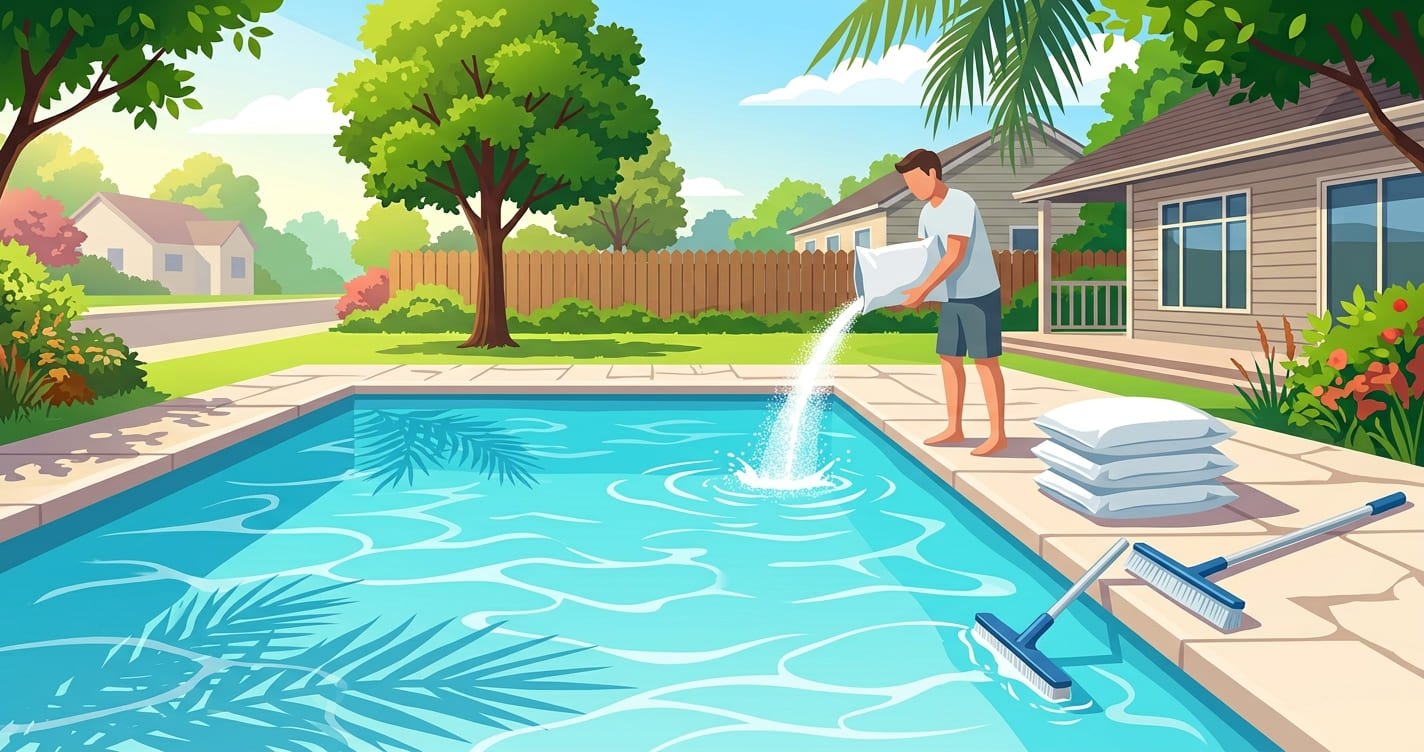
- Add the salt around the pool. Pour it across the shallow end or walk the perimeter. Keep it away from the skimmer, so undissolved salt doesn’t go straight through the equipment.
- Brush. Push any piles around the floor until they’re gone. Salt left sitting on a surface can mark it.
- Circulate. Run the pump for 24 hours. For a large dose or cool water, the Pool Factory and Poolonomics allow up to 48 hours.
- Retest. Confirm the level is in range.
- Turn the chlorinator back on.
For a big first dose, add about three quarters of it, circulate, retest, and then add the rest. It costs you a day and protects you from a wrong volume estimate. An overdose costs you water.
What if you added too much?
There’s no chemical that removes salt. Hayward’s manual says the only way to lower the concentration is to partially drain the pool and refill with fresh water.
The sum is simple, because fresh water is close to 0 ppm:
fraction of water to replace = (current ppm - target ppm) / current ppmFrom 4,000 ppm down to 3,200: (4,000 – 3,200) / 4,000 = 20% of the water. In a 10,000 gallon pool that’s 2,000 gallons.
Check whether you need to act at all. If you’re a little over the ideal but still inside your manual’s range, leave it. Splash-out and rain will bring it down over the season.
If you do drain, do it in stages and retest between each. Never empty a pool to chase a number. An empty shell can lift out of the ground when the water table is high, and a vinyl liner can shrink once it dries.
How often will you need to add salt?
Once the first dose is in, the question of how much salt to add to pool water rarely comes up. Salt isn’t used up. The cell turns it into chlorine, the chlorine does its work and turns back into salt. The Pool Factory puts it plainly: salt only leaves through backwashing, splashing or draining.
Evaporation works the other way. It takes water and leaves the salt, so the reading creeps up in a hot, dry spell and drops back when you top up. Rain that overflows the pool carries salt out with it.
If you replace 10% of the water over a season through backwashing and splash-out, a pool at 3,200 ppm falls to 2,880. For a 15,000 gallon pool, that’s a 40 lb top-up. Test monthly in the swimming season and after heavy rain, and you’ll catch it before the cell complains.
Common mistakes
- Using 3,200 ppm without checking the manual. It’s Hayward’s ideal. It’s below Pentair’s minimum.
- Not testing first. The current reading matters as much as the pool size when you work out how much salt to add to pool water.
- Trusting a rule of thumb. See above. It can be several times too much.
- Guessing the volume. A 20% error in volume is a 20% error in every dose.
- Testing too soon. An hour after adding salt, the reading means nothing. Wait a full day.
- Pouring salt into the skimmer. It sends a slug of very salty water through the pump, heater and cell.
- Adding more because the display still says low. A scaled or worn cell, or cold water, can cause a low reading. Check with a strip or meter before you add anything.
Related calculators
Salt is one job on a pool project. If you’re still at the building stage, our dirt calculator works out how many truckloads the excavation will produce, and the cubic yard calculator handles the concrete or sand for the base. For decorative stone around the pool, there’s the rock calculator.
Frequently asked questions
1. How much salt do I add to a 10,000 gallon pool?
From fresh water: 250 lb for a 3,000 ppm target, 267 lb for 3,200, or 300 lb for 3,600. For a top-up, it’s 8.3 lb for every 100 ppm you need to gain.
2. How much salt do I add to a 15,000 gallon pool?
From fresh water: 376 lb to reach 3,000 ppm, 401 lb for 3,200, or 451 lb for 3,600. In 40 lb bags that’s 10, 10 or 12 bags. Ten bags is 400 lb, which is within a pound of the 3,200 ppm dose.
3. How many 40 lb bags of salt do I need?
Work out the pounds, divide by 40 and round up. A 20,000 gallon pool going from 2,400 to 3,200 ppm needs 134 lb, so four bags.
4. How much does one bag of salt raise the level?
A 40 lb bag raises 10,000 gallons by about 479 ppm, 15,000 gallons by 320 ppm and 20,000 gallons by 240 ppm.
5. What should my pool’s salt level be?
Whatever your chlorinator’s manual says. Jandy TruClear asks for 3,000 ppm, Hayward Aqua Trol 3,200, and Pentair IntelliChlor 3,600. Their ranges don’t all overlap.
6. Can you put too much salt in a pool?
Yes. Above the manual’s maximum, the chlorinator may shut down, and very salty water is harder on metal parts. The only fix is to drain part of the water and refill.
7. How long after adding salt can I swim?
Salt at pool levels isn’t harmful, so the wait is about comfort and undissolved grains underfoot. Many owners swim once the salt has dissolved. Check your pool or chlorinator manual, and hold off if you added other chemicals at the same time.
8. How long does pool salt take to dissolve?
Up to 24 hours with the pump running, and up to 48 hours for a large dose or a big pool. Brushing speeds it up. Fine salt dissolves faster than coarse.
9. Why does my chlorinator say low salt when the test says it’s fine?
The display reads through the cell. Scale on the plates, an ageing cell or cold water can all pull the reading down. Confirm with a strip or a digital meter, and inspect the cell before you add salt.
10. Can I use water softener salt?
Only if it’s plain sodium chloride with no additives, and check the purity on the bag. Pool-grade salt is 99.8% pure. A lower purity means you need slightly more product.
Work out your dose
You now have everything you need to work out how much salt to add to pool water by hand. If you’d like the brand target filled in, the volume worked out from measurements, and the answer in bags of your size, use the pool salt calculator. It also tells you how much water to replace if the level is too high. It runs in your browser and stores nothing. The rest of our calculators are on the all tools page, and there are more explainers in our guides.
Sources
- Hayward Aqua Trol Operation and Installation Manual: salt range, ideal level, dosing chart, and the statement on lowering salt.
- Jandy Pro Series TruClear Installation and Operation Manual: required salt level and dosing table.
- Pentair IntelliChlor IC15/20/40/60 Installation and User’s Guide: salt range and ideal level.
- Swim University, “Pool Salt Calculator”: salt purity, and switching the generator off while salt dissolves.
- The Pool Factory, “How Much Salt to Add to Your Pool”: dissolving time, display wait time, salt purity, and how salt leaves a pool.
- Poolonomics, “Pool Salt Calculator”: adding steps and circulation time.
Tools in this guide
Pool Salt Calculator
How much salt your pool needs, and how many bags to buy.
Dirt Calculator
Cubic yards, tons and truckloads of dirt, whether you are filling in or digging out.
Cubic Yard Calculator
Cubic yards for several areas of any shape, with extra for waste, bags and cost.
Rock Calculator
Tons and cubic yards of landscape rock, with an honest range for the weight.
All of them run in your browser. Nothing uploaded.
More guides

Home & Garden
How Much Rock Do I Need? Formula, Charts and Examples
How much rock do I need? Square feet x inches / 324 gives cubic yards, then multiply by tons per yard. Charts, depths, coverage and worked examples.
Tool: Rock Calculator
Home & Garden
How Much Sand Do I Need? Pavers, Sandboxes and More
How much sand do I need? Get the formula, the weight of dry and wet sand, and worked examples for paver bases, sandboxes, pool bases and fish tanks.
Tool: Sand Calculator
Home & Garden
How Much Dirt Do I Need? Formula, Chart and Examples
How much dirt do I need? Use square feet x inches / 324 for cubic yards, then add for settling. Charts, weights, bags and worked examples inside.
Tool: Dirt Calculator
Last updated: October 6, 2026