
How Much Dirt Do I Need? Formula, Chart and Examples
How much dirt do I need? Use square feet x inches / 324 for cubic yards, then add for settling. Charts, weights, bags and worked examples inside.
How much dirt do I need? For most jobs the answer is one line of arithmetic: multiply the area in square feet by the depth in inches and divide by 324. That gives cubic yards, which is how bulk dirt is sold. A 20 ft by 10 ft patch raised by 6 inches needs 3.70 cubic yards in place, and about 4.26 once you allow for settling.
The arithmetic is the easy part. Orders go wrong on the things around it: the wrong depth, no allowance for settling, the wrong kind of dirt, or a truck that can’t carry what you asked for. This guide walks through each one, with worked numbers you can check.
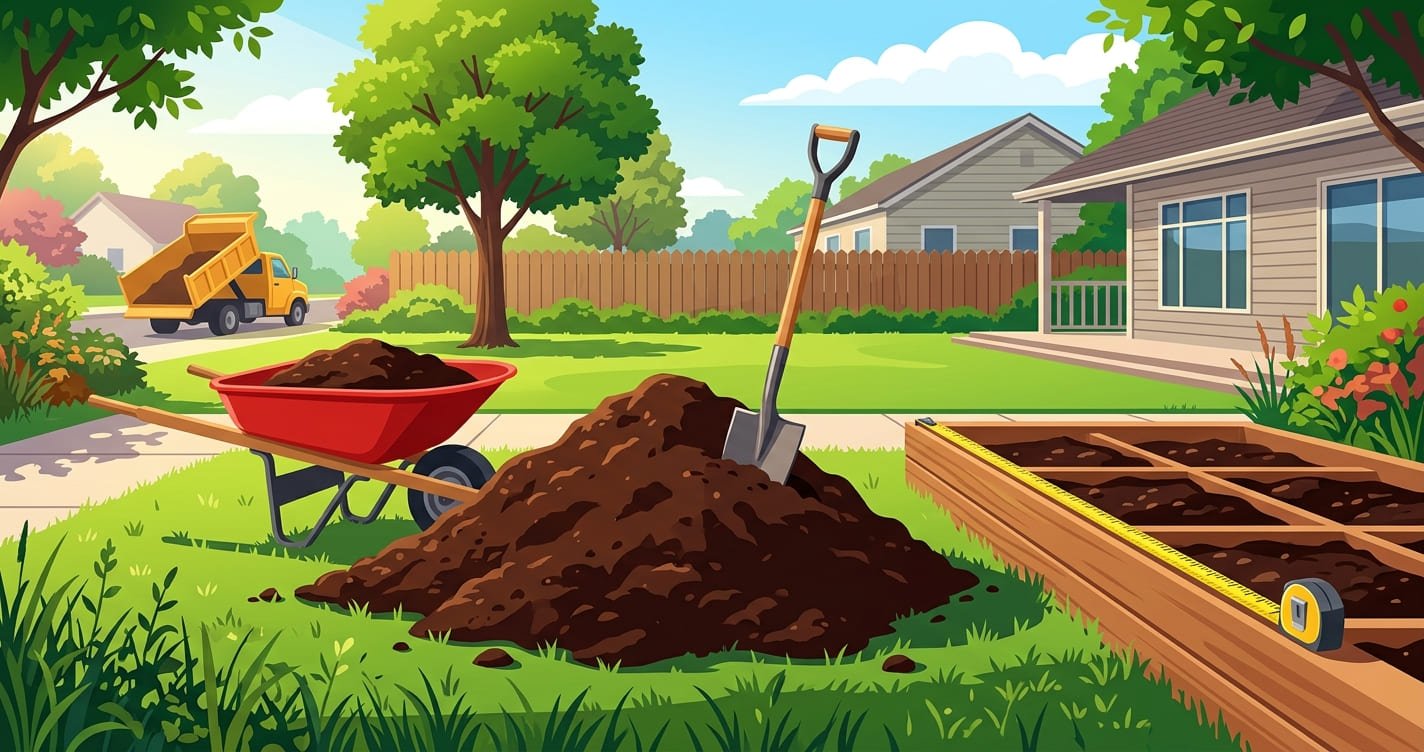
How much dirt do I need? The short answer
| Question | Short answer |
|---|---|
| The formula | Square feet x depth in inches / 324 = cubic yards |
| Same thing in feet | Length x width x depth (all in feet) / 27 = cubic yards |
| One cubic yard covers | 324 sq ft at 1 inch, 108 sq ft at 3 inches, 54 sq ft at 6 inches |
| How much extra | 5% to 10% for beds and lawns, 15% for general fill, 20% to 25% if you’ll compact it |
| What a yard weighs | Loose fill dirt: 2,070 to 2,700 lb, so 1.0 to 1.35 tons |
| Bags in a yard | 27 bags of 1 cubic foot, or 18 bags of 1.5 cubic feet |
| Digging instead of filling? | The pile is 5% to 67% bigger than the hole, depending on the soil |
If you’d rather not do it by hand, our dirt calculator takes the measurements and gives cubic yards, tons, truckloads and bags. It handles several areas at once and works for digging out as well as filling in.
How much dirt do I need? The formula
Dirt is sold by volume. Volume is area times depth. The only awkward part is units, because you measure the ground in feet, the depth in inches, and the supplier quotes cubic yards.
A cubic yard is a cube 3 feet on each side: 3 x 3 x 3 = 27 cubic feet. So:
cubic yards = length (ft) x width (ft) x depth (ft) / 27Depth in inches has to be divided by 12 to get feet. Fold that into the 27 and you get 12 x 27 = 324, which gives the shortcut:
cubic yards = square feet x depth (inches) / 324Both lines give the same answer. The second one saves a step and removes the most common mistake, which is typing 6 for the depth when the formula wanted 0.5.
A first example
You want to raise a 20 ft by 10 ft area by 6 inches.
- Area: 20 x 10 = 200 square feet.
- Volume: 200 x 6 / 324 = 3.70 cubic yards.
- Add 15% for settling: 3.70 x 1.15 = 4.26 cubic yards.
You’d order 4.5 cubic yards, since most suppliers sell in halves or whole yards.
Step 1: measure the area
Most yards aren’t one neat rectangle. Split the job into simple shapes, work out each one, and add them up.
| Shape | Area | Example |
|---|---|---|
| Rectangle | Length x width | 20 ft x 10 ft = 200 sq ft |
| Circle | 3.1416 x radius x radius | 12 ft across, so radius 6 ft: 113.1 sq ft |
| Triangle | Base x height / 2 | 20 ft base, 12 ft height: 120 sq ft |
| Ring (a border around something) | Outer circle minus inner circle | 16 ft across outside, 12 ft inside: 88.0 sq ft |
Two things to watch. A circle formula wants the radius, which is half the width across. And for an L-shaped area, cut it into two rectangles so you don’t count the corner twice.
For a curved or irregular bed, pace out the longest length and the average width and treat it as a rectangle. You’ll be within a few percent, and the settling allowance covers the rest.
Step 2: pick the depth
Depth changes the order more than anything else. Going from 2 inches to 4 inches doubles it. So decide the depth on purpose.
| Job | Typical depth | Notes |
|---|---|---|
| Leveling low spots or overseeding a lawn | About 2 inches | Hello Gravel calls a 2 inch layer standard for this |
| New in-ground garden bed | 6 to 8 inches | Hello Gravel’s range, to give roots room |
| Raised bed | The inside height of the bed | Measure the inside, not the outside of the boards |
| Raising the grade | Whatever the new level needs | Measure in several places and average |
| Filling a hole or trench | The depth of the hole | Take a few measurements. Holes are rarely flat-bottomed |
When the depth isn’t even, measure it in four or five spots and use the average. For a wedge that runs from nothing at one edge to full depth at the other, the average is half the full depth.
How far one cubic yard goes
Suppliers hear “how much dirt do I need” all day, and this table is how they answer it. It’s handy when the supplier asks “how many yards?” and you only know the area.
| Depth | One cubic yard covers |
|---|---|
| 1 inch | 324 sq ft |
| 2 inches | 162 sq ft |
| 3 inches | 108 sq ft |
| 4 inches | 81 sq ft |
| 6 inches | 54 sq ft |
| 8 inches | 40.5 sq ft |
| 12 inches | 27 sq ft |
And here are cubic yards for common areas, before any extra for settling:
| Area | 2 inches | 4 inches | 6 inches | 12 inches |
|---|---|---|---|---|
| 100 sq ft | 0.62 | 1.23 | 1.85 | 3.70 |
| 500 sq ft | 3.09 | 6.17 | 9.26 | 18.52 |
| 1,000 sq ft | 6.17 | 12.35 | 18.52 | 37.04 |
| 2,000 sq ft | 12.35 | 24.69 | 37.04 | 74.07 |
| 5,000 sq ft | 30.86 | 61.73 | 92.59 | 185.19 |
Step 3: add extra for settling
Ask “how much dirt do I need” and most people stop at the volume. Settling is the step they skip, and it’s why so many jobs end an inch or two low.
Dirt comes off the truck loose, full of air gaps. Rain, its own weight and your feet pack it down. The Federal Highway Administration’s earthwork guidance gives a sense of scale: a cubic yard of earth in the ground can take up 1.25 cubic yards in a truck, then end up as only 0.65 to 0.85 cubic yards once it’s compacted into a fill.
Suppliers suggest different allowances, and they don’t agree:
- Hello Gravel says topsoil often loses 10% to 15% of its volume in the first few weeks, and suggests adding 10%.
- Gravelshop adds a fixed 15% to its fill dirt estimates.
- Soil Depot suggests 15% to 25% when the fill will be compacted.
- Bama Dirt suggests 5% to 10% for general jobs.
A workable rule from those:
| Job | Extra to add |
|---|---|
| Garden bed, raised bed, lawn top-up (not compacted) | 5% to 10% |
| General fill, raising a grade | 15% |
| Fill you’ll tamp or roll | 20% to 25% |
One exception. Fill under a slab, a driveway or a retaining wall is compacted in layers to a specified density, and a percentage won’t do. The FHWA lists loose loam at 2,070 to 2,360 lb per cubic yard and compacted loam at 3,520 lb, which is about 1.5 to 1.7 loose yards for each finished yard. For that kind of work, get the quantity from the engineer or contractor.
Fill dirt or topsoil?
Before “how much dirt do I need” comes “which dirt”. The word covers two different products, and ordering the wrong one is a more expensive mistake than ordering the wrong amount.
Fill dirt is subsoil with little organic matter. It packs firmly and stays put. Use it to raise ground, fill holes and build a base.
Topsoil is the upper layer of soil, with the organic matter plants need. Use it for lawns, beds and planters. It keeps settling as that organic matter breaks down, so it’s a poor choice under anything that must not move.
Many jobs use both: fill dirt for the bulk, then a few inches of topsoil on top where grass or plants will grow. Work each layer out separately. If the top layer is the main job, the topsoil calculator also compares bulk against bags and handles a soil and compost mix.
How much dirt do I need? Worked examples
Raised garden beds
Three beds, each 4 ft by 8 ft, filled 12 inches deep.
- Area: 3 x 4 x 8 = 96 square feet.
- Volume: 96 x 12 / 324 = 3.56 cubic yards.
- With 10% extra: 3.91 cubic yards.
In bags of 1.5 cubic feet, that’s 71 bags. At that size, a bulk delivery of 4 yards is usually the easier route.
A new lawn
You’re spreading 4 inches of topsoil over 1,000 square feet before seeding.
- Volume: 1,000 x 4 / 324 = 12.35 cubic yards.
- With 10% extra: 13.58 cubic yards.
Order 14 yards. In a 10 cubic yard truck that’s two deliveries.
A circular area
A round seating area 12 ft across needs building up by 4 inches.
- Radius: 6 ft. Area: 3.1416 x 6 x 6 = 113.1 square feet.
- Volume: 113.1 x 4 / 324 = 1.40 cubic yards.
- With 15% extra: 1.61 cubic yards.
A slope to fix drainage
Water runs toward the house, and you want the ground to fall away from it. You’re building a wedge along 30 ft of wall, 12 ft out, that is 10 inches deep at the wall and tapers to nothing.
- Area: 30 x 12 = 360 square feet.
- Average depth: half of 10 inches, so 5 inches.
- Volume: 360 x 5 / 324 = 5.56 cubic yards.
- With 15% extra: 6.39 cubic yards.
Use fill dirt for this, not topsoil, and keep the finished soil below the siding. Local building codes set how much fall is required near a foundation, so check yours before you settle on the depth.
Filling an old pond
A pond hole is roughly 10 ft by 8 ft and 2 ft deep at the middle, shallower at the edges. You measure the depth in five places and the average is 18 inches.
- Area: 10 x 8 = 80 square feet.
- Volume: 80 x 18 / 324 = 4.44 cubic yards.
- With 20% extra, because a deep fill settles a lot: 5.33 cubic yards.
Fill a hole this deep in layers and tamp each one, or it will sink over the first winter.
How much does the dirt weigh?
How much dirt do I need in tons? You order by the yard, but weight decides what can carry it. These are the loose weights our calculator uses, drawn from Caterpillar’s material density table and the Federal Highway Administration’s earthwork guidance.
| Soil | Loose weight per cubic yard | In tons |
|---|---|---|
| Fill dirt (loam, common earth) | 2,070 to 2,700 lb | 1.04 to 1.35 |
| Topsoil | 1,600 to 2,600 lb | 0.80 to 1.30 |
| Clay | 2,010 to 2,800 lb | 1.01 to 1.40 |
| Sand or sandy soil | 2,400 to 3,230 lb | 1.20 to 1.62 |
The ranges are wide because water is heavy. Caterpillar lists dry sand at 2,400 lb per loose cubic yard and wet sand at 3,100 lb. After rain, plan toward the top of the range.
So the 4.26 cubic yards from the first example weighs 4.41 to 5.75 tons as fill dirt. That matters if you were thinking of collecting it yourself. A single cubic yard of fill dirt is over a ton, which is more than many pickup trucks are rated to carry. Check the payload figure on the sticker inside the driver’s door before you ask the yard to load you.
Bags or bulk?
For a small job, “how much dirt do I need” really means “how many bags”. A cubic yard is 27 cubic feet. Bagged soil is labeled in cubic feet, so the conversion is simple.
| Bag size | Bags in one cubic yard |
|---|---|
| 0.75 cubic feet | 36 |
| 1 cubic foot | 27 |
| 1.5 cubic feet | 18 |
| 2 cubic feet | 13.5, so 14 |
Bags suit small jobs: a planter, one raised bed, patching a few low spots. You can carry them through a gate, store what’s left, and there’s no pile on the driveway.
Bulk suits anything over a yard or two. Prices vary a lot by region and season, so compare for yourself: take the price of one bag, multiply by the number of bags in a yard, and set that against the delivered price per yard from a local supplier, including the delivery fee.
How many truckloads?
A truck has two limits: how much fits in the bed and how much weight it can legally carry. Light, fluffy soil fills the bed first. Wet clay or sand reaches the weight limit first, and the truck leaves part full.
Truck sizes vary. Our calculator starts at 10 cubic yards per load, but that’s only a starting figure. Ask your supplier what their truck carries, in yards and in tons, and whether there’s a minimum order. Also ask where they can dump. A loaded truck is heavy enough to crack a driveway or sink into a soft lawn, so many drivers will only tip at the curb.
If you’re digging out, the numbers change
Everything above is about bringing dirt in. If you’re taking it out, for a pool, a trench or a foundation, the question flips from “how much dirt do I need” to “how much dirt will I have”. You need to know how big the pile will be, and it’s bigger than the hole.
Dug soil swells because of the gaps between the lumps. How much depends on the soil:
| Soil | Swell when dug |
|---|---|
| Fill dirt (loam, common earth) | 24% to 50% |
| Topsoil | 44% to 56% |
| Clay | 21% to 67% |
| Sand | 5% to 13% |
Those ranges combine Caterpillar’s figures and the FHWA’s, which differ. A pool hole 30 ft by 15 ft and 5 ft deep is 83.33 cubic yards in the ground. In ordinary loam it becomes 103.33 to 125 cubic yards on the surface. In 10 cubic yard trucks that’s 11 to 13 loads. Book trucks for the size of the hole alone and you’d have planned 9.
If the dig produces clean soil and you also need fill somewhere on the same property, reuse it. Just remember it goes the other way too: loose soil shrinks when you pack it back in.
Seven mistakes that cause a bad order
- Leaving depth in inches in the feet formula. Six inches is 0.5 ft. Use the 324 shortcut and the problem goes away.
- Ordering the exact volume. Loose dirt settles. With no allowance, you finish low.
- Using the diameter as the radius. That makes a circle four times too big.
- Treating a cubic yard as a ton. A loose yard of fill dirt is 1.0 to 1.35 tons. If the supplier sells by the ton, ask for their conversion.
- Ordering topsoil for structural fill. It keeps settling. Use fill dirt underneath.
- Measuring the outside of a raised bed. The boards take up room. Measure inside.
- Guessing at an uneven depth. Measure in several spots and average them.
Before you call the supplier
Have these ready and the call takes two minutes:
- The cubic yards you need, with the extra already added.
- The type: fill dirt, screened topsoil, or a blend.
- Whether they sell by the yard or by the ton.
- Where the truck can tip, and how wide the access is.
- Whether you want it all in one load or split.
Ask whether the fill dirt is clean, meaning free of rubble, roots and rubbish. Cheap or free fill sometimes isn’t. And before any digging at all, have underground utilities marked. In the US, call 811.
Other materials for the same project
The answer to “how much dirt do I need” is rarely the whole shopping list. For mulch or concrete, where swell and weight don’t matter, the cubic yard calculator gives volume and bags. For gravel, pea gravel and river rock, which are sold by the ton, use the rock calculator. If a wall is going on the new grade, the concrete block calculator counts blocks and mortar.
Frequently asked questions
1. How much dirt do I need for a 4×8 raised bed?
At 12 inches deep, 32 square feet x 12 / 324 = 1.19 cubic yards, or about 1.3 with 10% extra. At 6 inches deep it’s half that: 0.59 cubic yards. In 1.5 cubic foot bags, a 12 inch bed takes 22 bags before any extra.
2. How much dirt do I need to cover 1,000 square feet?
It depends on the depth. At 2 inches it’s 6.17 cubic yards, at 4 inches 12.35, and at 6 inches 18.52. Add 10% to 15% for settling.
3. How much dirt do I need to fill a hole?
Measure the length, the width and the average depth, then use square feet x inches / 324. Add 15% to 25%, because a deep fill settles more than a thin layer. Fill in layers and tamp each one.
4. How many square feet does a cubic yard of dirt cover?
324 square feet at 1 inch deep. Divide 324 by the depth in inches for anything else: 162 at 2 inches, 108 at 3 inches, 81 at 4 inches and 54 at 6 inches.
5. How much does a cubic yard of dirt weigh?
Loose fill dirt weighs 2,070 to 2,700 lb per cubic yard, which is 1.04 to 1.35 tons. Topsoil runs 1,600 to 2,600 lb. Wet soil sits at the top of those ranges.
6. How many bags of dirt make a cubic yard?
A cubic yard is 27 cubic feet. That’s 27 bags of 1 cubic foot, 18 bags of 1.5 cubic feet, or 36 bags of 0.75 cubic feet.
7. How much dirt do I need if I’m going to compact it?
Add 20% to 25% for fill you’ll tamp or roll yourself. For structural fill under a slab, driveway or wall, it can take 1.5 to 1.7 loose yards for each finished yard, and the quantity should come from the engineer or contractor.
8. Is dirt sold by the yard or by the ton?
Both. Landscape suppliers mostly quote cubic yards. Quarries and some haulers quote tons. Ask which, and ask for their conversion, since the weight of a yard changes with the soil and how wet it is.
9. Can I pick up a yard of dirt in a pickup truck?
A yard of fill dirt weighs over a ton, which is more than many pickups are rated for. Check the payload on the door sticker. If you’re over, take half a yard at a time or have it delivered.
10. Should I use fill dirt or topsoil?
Fill dirt to raise ground, fill holes or build a base, because it packs and stays put. Topsoil where plants will grow. For a large fill that will be planted, use fill dirt for the bulk and finish with a few inches of topsoil.
Work out your order
You can answer “how much dirt do I need” with a tape measure and the 324 shortcut. If the job has more than one area, a mix of shapes, or a dig as well as a fill, the dirt calculator does it in one pass and shows its working, so you can check it against a contractor’s figure. It runs in your browser and stores nothing. More calculators are on the home and garden tools page.
Sources
- Caterpillar, “Material Density Tables to Help Estimate Earthwork Volumes”: loose and in-ground weights, and the figures behind the swell ranges.
- Federal Highway Administration, Federal Lands Highway Project Development and Design Manual, Earthwork Design, Exhibit 5.1-A: densities, percent swell, and the 1.25 and 0.65 to 0.85 cubic yard example.
- Hello Gravel, “How Much Topsoil Do I Need?” (August 18, 2026): depths for lawn repair and garden beds, and the 10% to 15% settling figure.
- Gravelshop, Soil Depot and Bama Dirt calculator pages: settling and compaction allowances.
Tools in this guide
Dirt Calculator
Cubic yards, tons and truckloads of dirt, whether you are filling in or digging out.
Topsoil Calculator
Cubic yards and bags of topsoil for lawns and beds, with a mix split and a bulk or bags check.
Cubic Yard Calculator
Cubic yards for several areas of any shape, with extra for waste, bags and cost.
Rock Calculator
Tons and cubic yards of landscape rock, with an honest range for the weight.
Concrete Block Calculator
Blocks, mortar and core fill for a block wall, with doors and windows taken off.
All of them run in your browser. Nothing uploaded.
More guides
Home & Garden
How Much Rock Do I Need? Formula, Charts and Examples
How much rock do I need? Square feet x inches / 324 gives cubic yards, then multiply by tons per yard. Charts, depths, coverage and worked examples.
Tool: Rock Calculator
Home & Garden
How Much Sand Do I Need? Pavers, Sandboxes and More
How much sand do I need? Get the formula, the weight of dry and wet sand, and worked examples for paver bases, sandboxes, pool bases and fish tanks.
Tool: Sand Calculator

Home & Garden
How Much Salt to Add to Pool Water: Formula and Charts
Work out how much salt to add to pool water with one formula. Charts by pool size, targets for Hayward, Jandy and Pentair, and how to fix too much.
Tool: Pool Salt Calculator
Last updated: October 6, 2026