
What Is a Saturn Return? Meaning, Ages and What to Expect
A Saturn return is when Saturn comes back to where it was at your birth, at about 29, 58 and 88. See what it means, when yours is and how long it lasts.
A Saturn return is the point in your life when the planet Saturn gets back to the exact place in the sky it occupied when you were born. Saturn takes about 29.5 years to circle the Sun, so your first Saturn return arrives in your late twenties, the second in your late fifties and the third in your late eighties. Astrologers treat each one as a turning point: a stretch when life asks you to grow up, take stock and commit.
This guide covers both sides. You’ll get what astrologers say a Saturn return means, and you’ll get the parts you can actually check: the astronomy, the real dates, how long it lasts, and what research says about why so many people’s lives change around 29 anyway.
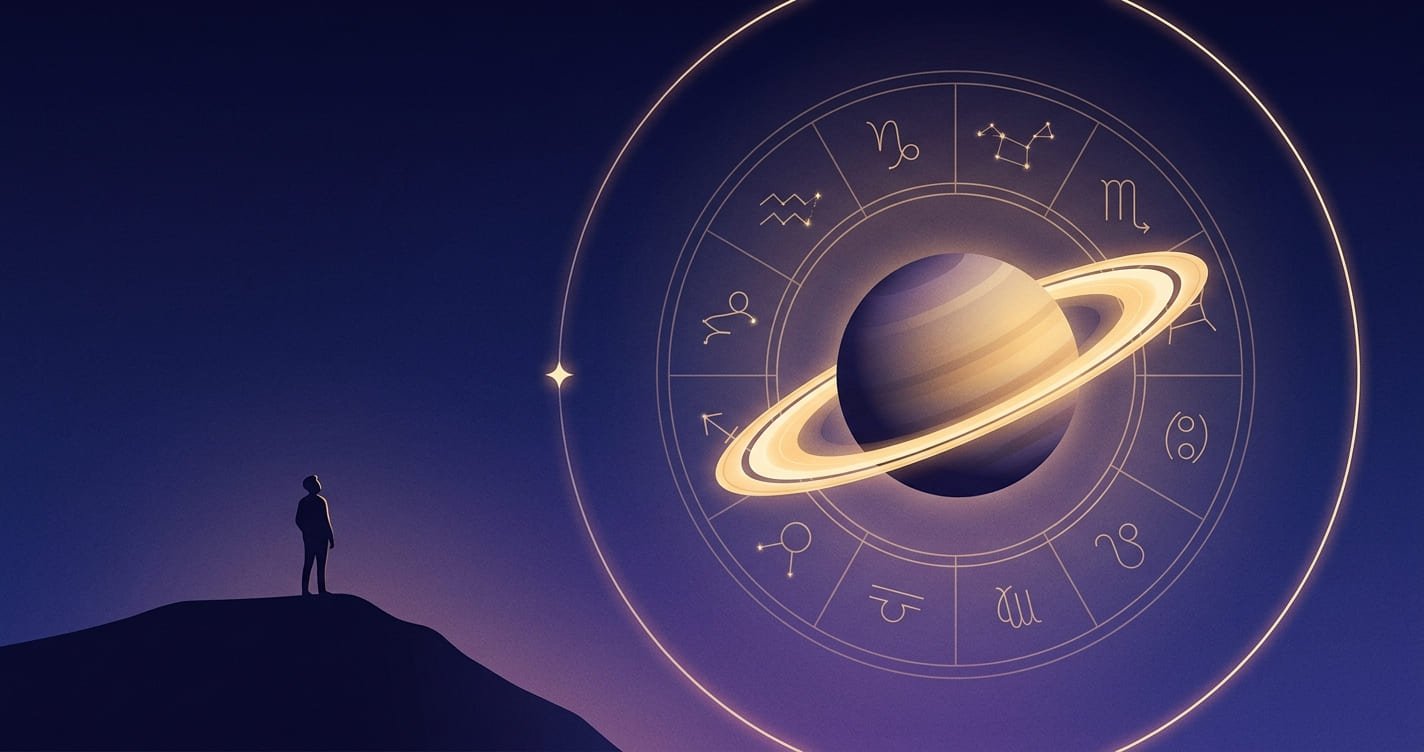
Saturn return at a glance
| Question | Short answer |
|---|---|
| What is it? | Saturn coming back to the zodiac position it held at your birth |
| How often? | About every 29.5 years, so up to three times in a long life |
| First return | Exact between ages 28.4 and 29.8 |
| Second return | Exact between ages 58.2 and 58.9 |
| Third return | Exact between ages 87.3 and 88.8 |
| How long does it last? | About 10 months near the exact point, or about 2.5 years by the looser “whole sign” definition |
| Who is in one now? | People born with Saturn in Aries: roughly April 1996 to March 1999, and March 1967 to April 1969 |
| Is it scientific? | The orbit is. The meaning isn’t proven. |
The age ranges come from our own Saturn return calculator, run across births from 1900 to 1999. To get your own dates, enter your birth details there. It takes a few seconds.
What is a Saturn return?
Picture the sky at the moment you were born as a clock face with twelve sections, one for each zodiac sign. Every planet sat somewhere on that face. Your birth chart is a map of those positions.
The planets keep moving. The Moon gets back to its starting point in about a month. The Sun takes a year, which is why you have a birthday. Saturn is slow. It needs about 29.5 years to go all the way round and arrive back where it started. That arrival is your Saturn return.
Because the cycle is so long, it lines up with life stages in a way faster planets can’t. One lap of Saturn takes you from birth to the end of your twenties. A second lap takes you to the edge of retirement. A third takes you into old age. That neat fit is a big part of why the idea has lasted.
What Saturn stands for in astrology
In Western astrology, each planet has a character. Saturn’s is the strict teacher. Astrologers link it with:
- Responsibility: duties you can’t hand to someone else.
- Structure: career, routine, long-term plans, the things you build slowly.
- Limits: time, money, energy, and the fact that you can’t do everything.
- Maturity: the gap between who you were told to be and who you are.
- Consequences: results that match the effort, good or bad.
So when Saturn comes home, astrologers say those themes come due. Anything built on weak foundations tends to wobble. Anything you’ve worked at tends to firm up.
When does a Saturn return happen?
Most articles say “between 27 and 30”. That’s roughly right, but it’s wider than it needs to be. When we calculated the exact moment for a sample of births across the twentieth century, the first exact return always fell between ages 28.4 and 29.8.
| Return | Exact return falls at age | Often described as | The usual theme |
|---|---|---|---|
| First | 28.4 to 29.8 | 27 to 30 | Becoming an adult on your own terms |
| Second | 58.2 to 58.9 | 56 to 60 | Legacy, and what the next chapter is for |
| Third | 87.3 to 88.8 | 84 to 90 | Reflection and acceptance |
Why do articles quote wider ranges? Because many astrologers count the whole time Saturn spends in your birth sign, not only the moment it reaches the exact degree. That brings us to the two definitions.
Two ways to define it
- The exact return. Saturn reaches the same degree it held at your birth. This is a specific date, sometimes three dates (more on that below).
- The sign return. Saturn enters the same zodiac sign it was in at your birth. It stays about 2.5 years, and astrologers call that whole stretch your Saturn return.
Neither is wrong. They answer different questions. The sign version tells you the season. The exact version tells you the peak. If you were born with Saturn near the end of a sign, your “season” can begin more than two years before your exact date.
How to find your Saturn sign
Your Saturn sign is not your star sign. Your star sign is where the Sun was. Your Saturn sign is where Saturn was, and since Saturn spends about 2.5 years in each sign, you share it with almost everyone in your school year and the years either side.
Find your birth date in the table. Dates are in UTC, and we worked them out with the same engine the calculator uses.
| Born between | Saturn sign |
|---|---|
| Jan 12 to May 14, 1956; Oct 10, 1956 to Jan 5, 1959 | Sagittarius |
| Jan 5, 1959 to Jan 3, 1962 | Capricorn |
| Jan 3, 1962 to Mar 24, 1964; Sep 16 to Dec 16, 1964 | Aquarius |
| Mar 24 to Sep 16, 1964; Dec 16, 1964 to Mar 3, 1967 | Pisces |
| Mar 3, 1967 to Apr 29, 1969 | Aries |
| Apr 29, 1969 to Jun 18, 1971; Jan 9 to Feb 21, 1972 | Taurus |
| Jun 18, 1971 to Jan 9, 1972; Feb 21, 1972 to Aug 1, 1973; Jan 7 to Apr 19, 1974 | Gemini |
| Aug 1, 1973 to Jan 7, 1974; Apr 19, 1974 to Sep 17, 1975; Jan 14 to Jun 5, 1976 | Cancer |
| Sep 17, 1975 to Jan 14, 1976; Jun 5, 1976 to Nov 17, 1977; Jan 4 to Jul 26, 1978 | Leo |
| Nov 17, 1977 to Jan 4, 1978; Jul 26, 1978 to Sep 21, 1980 | Virgo |
| Sep 21, 1980 to Nov 29, 1982; May 6 to Aug 24, 1983 | Libra |
| Nov 29, 1982 to May 6, 1983; Aug 24, 1983 to Nov 17, 1985 | Scorpio |
| Nov 17, 1985 to Feb 13, 1988; Jun 10 to Nov 12, 1988 | Sagittarius |
| Feb 13 to Jun 10, 1988; Nov 12, 1988 to Feb 6, 1991 | Capricorn |
| Feb 6, 1991 to May 21, 1993; Jun 30, 1993 to Jan 29, 1994 | Aquarius |
| May 21 to Jun 30, 1993; Jan 29, 1994 to Apr 7, 1996 | Pisces |
| Apr 7, 1996 to Jun 9, 1998; Oct 25, 1998 to Mar 1, 1999 | Aries |
| Jun 9 to Oct 25, 1998; Mar 1, 1999 to Aug 9, 2000; Oct 16, 2000 to Apr 20, 2001 | Taurus |
| Aug 9 to Oct 16, 2000; Apr 20, 2001 to Jun 3, 2003 | Gemini |
| Jun 3, 2003 to Jul 16, 2005 | Cancer |
Notice how some signs appear in two or three pieces. That’s Saturn’s retrograde at work: it crosses into a new sign, backs out for a few months, then returns for good. If you were born within a day of a boundary, the table can’t settle it, because the answer depends on your birth time and time zone. The calculator can. If you need to convert a birth time first, the time zone converter will do it.
Who is having a Saturn return right now?
Saturn entered Aries for a long stay on February 13, 2026, and remains there until April 13, 2028. (It also dipped into Aries from May 25 to September 1, 2025, before backing into Pisces.) By the sign definition, that puts three groups in a Saturn return today:
- First return: born April 7, 1996 to June 9, 1998, or October 25, 1998 to March 1, 1999.
- Second return: born March 3, 1967 to April 29, 1969.
- Third return: born between April 1937 and March 1940, with a few gaps, when Saturn made its previous pass through Aries.
Here’s what comes next.
| Saturn is in | From | Until | First return for people born |
|---|---|---|---|
| Aries | Feb 13, 2026 | Apr 13, 2028 | Apr 1996 to early 1999 |
| Taurus | Apr 13, 2028 | Jun 1, 2030 | Mid 1998 to Apr 2001 |
| Gemini | Jun 1, 2030 | Jul 14, 2032 | Aug 2000 to Jun 2003 |
| Cancer | Jul 14, 2032 | Aug 27, 2034 | Jun 2003 to Jul 2005 |
The birth ranges overlap at the edges because of those retrograde dips. Check your exact birth date against the Saturn sign table above.
How long does a Saturn return last?
This is where published answers disagree most, and it’s only because they measure different things.
- By sign: about 2.5 years, sometimes close to 3 when retrograde stretches it. This is the “it lasts three years” figure.
- By closeness to the exact degree: much shorter. Counting the time Saturn sits within 3 degrees of its birth position, a first return lasts 10.5 months on average. The shortest in our sample was 1.5 months and the longest 18.8.
- The exact moment: a single instant, or three of them.
That spread from 1.5 to 18.8 months is real, and it isn’t about you. It comes down to whether Saturn happens to be turning retrograde near your birth degree. If it is, it lingers. If it isn’t, it passes straight through.
Why some people get three exact dates
Once a year, Earth overtakes Saturn on the inside track. For about four and a half months, Saturn appears to drift backwards against the stars. It isn’t really reversing. It’s the same effect as a slower car seeming to slide backwards when you pass it on the motorway.
If that backward stretch happens right around your natal Saturn, the planet crosses your exact degree going forwards, crosses it again going back, then crosses it a third and final time. In our sample, 145 of 377 first returns had three passes. That’s about 38%.
Astrologers often describe the three passes as a story in three acts: the issue appears, you rework it, then you settle it. Whether or not that matches your experience, it helps to know that three dates aren’t an error. They’re orbital mechanics.
The first Saturn return: your late twenties
This is the famous one. Astrologers describe the first Saturn return as the real start of adulthood: the end of the trial period. Common themes include:
- Career: leaving a job that never fitted, going back to study, or finally committing to a path.
- Relationships: ending one that wasn’t working, or making one permanent.
- Home: moving city or country, or putting down roots for the first time.
- Identity: dropping goals you inherited from parents or peers.
- Money: getting serious about debt, savings and what things cost.
People often say it feels like pressure followed by clarity. The pressure comes from seeing that some choices can’t be put off any longer. The clarity comes from making them.
Pop culture has picked up the idea more than once. No Doubt named their 2000 album Return of Saturn, written as Gwen Stefani approached 30. Adele has talked about her Saturn return in connection with her album 30. Ariana Grande put a “Saturn Returns Interlude” on Eternal Sunshine in 2024, and Kacey Musgraves sings about her own Saturn returning on the title track of Deeper Well, released the same year.
The second Saturn return: your late fifties
The second Saturn return gets far less attention and arguably matters more. It falls at about 58, when many people are asking a different question. The first return asks “who am I going to be?” The second asks “what was it all for, and what do I do with the time left?”
Themes astrologers associate with it:
- Work: stepping back, changing role, or planning retirement.
- Legacy: what you’ll leave behind, in family, work or community.
- Health: taking the body’s limits seriously.
- Relationships: a marriage after children leave, ageing parents, becoming a grandparent.
- Unlived plans: the thing you always meant to do.
The exact second return falls in a much narrower age band than the first: 58.2 to 58.9 in our sample. If the money side of that chapter is on your mind, our Coast FIRE calculator shows whether your savings can already carry you to retirement.
The third Saturn return: your late eighties
Few articles say much about the third return, at about 87 to 89, and not everyone reaches it. Astrologers describe it as a time of looking back, making peace and passing on what you know. It’s less about building and more about meaning. If you have a parent or grandparent of that age, it can be a good prompt to ask for their stories.
What your Saturn sign is said to mean
Astrologers say the sign Saturn was in at your birth shapes what your Saturn return is about. These are the traditional associations, in brief.
| Saturn sign | The lesson astrologers assign |
|---|---|
| Aries | Independence, courage, acting without waiting for permission |
| Taurus | Money, security, and what you truly value |
| Gemini | Communication, learning, focus |
| Cancer | Home, family, emotional safety |
| Leo | Self-expression, confidence, creative work |
| Virgo | Health, daily routine, doing the work well |
| Libra | Partnership, fairness, boundaries with other people |
| Scorpio | Trust, intimacy, control, shared money |
| Sagittarius | Beliefs, education, freedom and its costs |
| Capricorn | Career, ambition, authority |
| Aquarius | Community, individuality, your place in a group |
| Pisces | Compassion, escapism, boundaries with yourself |
A full reading goes further and looks at which of the twelve “houses” Saturn sits in and what angles it makes to other planets. That needs an accurate birth time and, usually, an astrologer.
What science says about the Saturn return
We’d rather be straight with you than sell you a mood. Here’s where things stand.
The astronomy is solid. Saturn really does return to the same place in the sky about every 29.5 years. That can be calculated to within hours.
The astrology is not established. The best-known controlled test is a double-blind study by physicist Shawn Carlson, published in the journal Nature in 1985. Astrologers were asked to match birth charts to personality profiles and did no better than chance. Later tests have reached similar results. Nobody has shown that Saturn’s position affects careers or relationships.
So why does it feel so accurate? A few reasons that don’t need a planet:
- The late twenties are a turning point anyway. Psychologist Daniel Levinson described an “age thirty transition” in the 1970s, a period from about 28 to 33 when adults commonly rework the life they set up in their early twenties. He wasn’t writing about astrology.
- Ages ending in 9 prompt soul-searching. A 2014 study by Adam Alter and Hal Hershfield in PNAS found that people at 29, 39, 49 and so on were more likely to question whether their lives had meaning, and to act on it.
- Big milestones cluster there. In many countries, first marriages, first children and first home purchases now fall in the late twenties and early thirties.
- General statements feel personal. Psychologists call it the Barnum or Forer effect: descriptions like “you’re reassessing what matters” fit nearly everyone, so nearly everyone recognises themselves.
- A wide window catches a lot. If a Saturn return runs from 27 to 30, something important is almost certain to happen inside it.
None of this means the idea is useless. Plenty of people find a Saturn return a helpful frame: a scheduled moment to ask hard questions. You can use it that way without believing a planet is steering.
How to get through a Saturn return
This advice holds up whether you credit Saturn or simply your age.
- Audit, don’t panic. List the big structures in your life: work, relationship, home, money, health. Mark each one “chosen” or “drifted into”.
- Fix one thing at a time. Changing job, city and partner in the same month is a recipe for regret. Pick the one that weighs most.
- Take the boring steps. A budget, a medical check-up, a difficult conversation, a qualification. Saturn’s reputation is for rewarding effort that isn’t glamorous.
- Stop comparing timelines. Your friends’ weddings and promotions are not a deadline for you.
- Write it down. Notes on what you want, kept over months, are far more useful than one dramatic decision. If you get three passes, review them at each one.
- Get proper help when you need it. If you feel persistently low, anxious or stuck, talk to a doctor or a therapist. A transit is not a diagnosis, and you don’t have to wait for it to end.
It can also help to know your dates so the period has edges. Once you have them, the date duration calculator will tell you how many days remain until your exact return, and the age calculator will tell you exactly how old you’ll be on the day.
How to calculate your Saturn return
You can do it by hand with a table of planetary positions, but it’s fiddly, because retrograde motion means there may be three answers. The quicker way:
- Open the Saturn return calculator.
- Enter your date of birth. Add your birth time and place if you know them.
- Read off your Saturn sign and degree, then your first, second and third return dates, including every exact pass.
No birth time? You don’t need one. Saturn moves only a few arcminutes a day, so an unknown time shifts each date by less than a day in half of cases and by under two days in 90%. The calculator shows that range instead of guessing. It runs in your browser, and your birth details are never uploaded.
Common myths about the Saturn return
- “It starts on your 27th birthday.” It doesn’t follow birthdays. It depends on where Saturn was when you were born.
- “It lasts exactly three years.” That’s the loosest definition. Near the exact point, it averages about 10 months.
- “It’s always a disaster.” Even astrologers don’t say this. They describe it as a time when effort gets paid back. Many people marry, graduate or get promoted during it.
- “It’s the same as your star sign.” Your Saturn sign is usually different from your Sun sign.
- “Everyone your age goes through it together.” Roughly, by sign. But two people born a year apart can have exact dates more than a year apart.
- “You only get one.” You get up to three.
Saturn return FAQs
1. What is a Saturn return in simple terms?
It’s when Saturn finishes one full lap of the zodiac and comes back to where it was on the day you were born. That takes about 29.5 years. Astrologers see it as a major life checkpoint.
2. At what age is your Saturn return?
The first exact Saturn return falls between ages 28.4 and 29.8. The second falls at about 58 and the third at about 88. Many astrologers say the effects begin a year or two earlier, when Saturn enters your birth sign.
3. How do I know when my Saturn return is?
You need your date of birth, and ideally your birth time and place. Enter them in a Saturn return calculator and it will give you the exact dates. Without a birth time, the dates are still accurate to within a day or two.
4. How long does a Saturn return last?
Counted by sign, about 2.5 years. Counted as the time Saturn is within 3 degrees of its birth position, about 10.5 months on average, ranging from 1.5 to 18.8 months.
5. What happens during a Saturn return?
Astrologers say the themes are responsibility, commitment and honest self-assessment. In practice, people often change jobs, end or formalise relationships, move home, or get serious about money and health.
6. Is a Saturn return always bad?
No. It has a reputation for being hard because it’s linked with endings and pressure. But the same period brings marriages, promotions and long-awaited decisions. The tradition says you get out what you’ve put in.
7. What is the second Saturn return?
It’s Saturn’s second arrival at its birth position, at about age 58. Astrologers connect it with legacy, retirement, health and deciding how to use the next stage of life.
8. Why does my Saturn return have three dates?
Because of retrograde motion. For about four and a half months each year Saturn appears to move backwards. If that happens near your birth degree, Saturn crosses it forwards, backwards and forwards again. About 38% of first returns work this way.
9. Who is in their Saturn return in 2026 and 2027?
Saturn is in Aries from February 13, 2026 to April 13, 2028. People born with Saturn in Aries are in their return: roughly April 1996 to March 1999 for a first return, and March 1967 to April 1969 for a second.
10. Is the Saturn return real?
The orbit is real and precisely predictable. The claim that it shapes your life isn’t supported by controlled studies. Many people still find it a useful prompt for reflection at an age when change is common anyway.
Find your dates
If you take one thing from this guide, make it this: a Saturn return is a date you can look up, not a vague cloud hanging over your late twenties. Get your exact dates from the Saturn return calculator, see whether you have one pass or three, and decide for yourself what to do with the time. For more explainers like this one, browse our guides.
Sources
- Saturn’s position, sign dates, return ages, window lengths and the share of returns with three passes: calculated with the FreeToolBank Saturn return engine, which is checked against NASA JPL data.
- Carlson, S. (1985). “A double-blind test of astrology.” Nature, 318, 419 to 425.
- Levinson, D. J. (1978). The Seasons of a Man’s Life. Knopf.
- Alter, A. L., and Hershfield, H. E. (2014). “People search for meaning when they approach a new decade in chronological age.” PNAS, 111(48), 17066 to 17070.
- Forer, B. R. (1949). “The fallacy of personal validation.” Journal of Abnormal and Social Psychology, 44(1), 118 to 123.
Tools in this guide
Saturn Return Calculator
When your 1st, 2nd and 3rd Saturn returns happen, to the day.
Age Calculator
Work out an age, or the gap between two people.
Date Duration Calculator
Count the days between two dates, both ways.
Time Zone Converter
Convert between zones and UTC, with a live UTC clock.
CoastFIRE Calculator
The number that lets you stop saving and still retire on time.
All of them run in your browser. Nothing uploaded.
More guides

Home & Garden
How Much Sand Do I Need? Pavers, Sandboxes and More
How much sand do I need? Get the formula, the weight of dry and wet sand, and worked examples for paver bases, sandboxes, pool bases and fish tanks.
Tool: Sand Calculator

Home & Garden
How Much Rock Do I Need? Formula, Charts and Examples
How much rock do I need? Square feet x inches / 324 gives cubic yards, then multiply by tons per yard. Charts, depths, coverage and worked examples.
Tool: Rock Calculator

Home & Garden
How Much Salt to Add to Pool Water: Formula and Charts
Work out how much salt to add to pool water with one formula. Charts by pool size, targets for Hayward, Jandy and Pentair, and how to fix too much.
Tool: Pool Salt Calculator
Last updated: October 3, 2026