
Maryland Paycheck Calculator
Enter your salary or hourly wage to see your 2026 take-home pay after federal income tax, Social Security, Medicare, Maryland state tax and the local tax for your county. It covers all 24 Maryland jurisdictions, including Frederick County's whole-income rate, and people who live in Pennsylvania, DC, Virginia, West Virginia or another state.
Your take-home pay
$0.00
| Line | Per paycheck | Per year |
|---|
Show the working
An estimate of 2026 withholding using the IRS and Maryland Comptroller methods, not tax advice. Your employer's payroll system, your exact W-4 and MW507, and year-to-date pay can change the real figures by a few dollars.
Runs in your browser. Nothing uploaded.
This Maryland paycheck calculator shows what lands in your bank account after every 2026 deduction: federal income tax, Social Security, Medicare, Maryland state tax, and the local income tax your county or Baltimore City charges. That last one is the part most people forget. Every Maryland jurisdiction taxes income, at rates from 2.25% to 3.30%, so two people with the same salary can take home different amounts depending on where they live.
Every rate on this page comes from the 2026 IRS withholding tables and the Maryland Comptroller’s 2026 Employer Withholding Guide. The calculator follows the same method your employer’s payroll system uses, and it shows its working line by line.
How to use the Maryland paycheck calculator
- Enter your pay. Pick salary or hourly. For hourly pay, add your usual weekly hours and any overtime, which the calculator pays at 1.5 times your rate. Then choose how often you get paid.
- Copy your federal W-4. Choose your filing status and enter the dependent credit total from Step 3. If you filled in Step 4 (other income, deductions or extra withholding), open More W-4 options.
- Set your Maryland details. Choose where you live and your county. Enter the number of exemptions from your Form MW507, the Maryland version of the W-4.
- Add deductions. Enter any 401(k) percentage, pre-tax health or HSA contributions, and after-tax deductions. Your take-home pay updates as you type.
What comes out of a Maryland paycheck
A typical Maryland paycheck has five tax lines. Three are federal and two are Maryland’s.
| Deduction | Rate in 2026 | What sets it |
|---|---|---|
| Federal income tax | 0% to 37% | Your W-4 and the IRS 2026 tables |
| Social Security | 6.2% | Stops once you earn $184,500 in the year |
| Medicare | 1.45% | Plus 0.9% on pay over $200,000 |
| Maryland state tax | 4.75% to 6.5% withheld | Your MW507 and the state brackets |
| County or city tax | 2.25% to 3.30% | Where you live on December 31 |
Maryland has no state disability tax and, for 2026, no paid family leave deduction. The county tax is the line that surprises people who move here from another state.
Maryland state income tax in 2026
Maryland taxes income in ten brackets, from 2% to 6.5%. The two top brackets, 6.25% and 6.5%, arrived with the 2025 tax changes. Your employer, though, never uses the lowest brackets. Maryland law does not let employers withhold at less than 4.75%, so the 2%, 3% and 4% brackets only show up when you file your return.
That makes withholding simpler than it looks. For most people, Maryland state withholding is a flat 4.75% of taxable wages.
| Withholding rate | Single or married filing separately | Married filing jointly or head of household |
|---|---|---|
| 4.75% | Up to $100,000 | Up to $150,000 |
| 5.00% | $100,000 to $125,000 | $150,000 to $175,000 |
| 5.25% | $125,000 to $150,000 | $175,000 to $225,000 |
| 5.50% | $150,000 to $250,000 | $225,000 to $300,000 |
| 5.75% | $250,000 to $500,000 | $300,000 to $600,000 |
| 6.25% | $500,000 to $1,000,000 | $600,000 to $1,200,000 |
| 6.50% | Over $1,000,000 | Over $1,200,000 |
Taxable income after the $3,400 standard deduction and your exemptions. Source: Maryland Withholding Tax Facts, January to December 2026.
Each rate applies only to the income inside its band. A single filer with $110,000 of taxable income pays 4.75% on the first $100,000 and 5% on the last $10,000.
Maryland county income tax rates for 2026
Maryland’s 23 counties and Baltimore City each charge a local income tax. It is not a separate return. The Comptroller collects it with your state tax, and your employer withholds it from the same paycheck.
The local rate depends on where you live, not where you work. Someone who lives in Worcester County and commutes to Montgomery County pays Worcester’s 2.25%.
| Jurisdiction | 2026 local rate |
|---|---|
| Allegany County | 3.20% (up from 3.03%) |
| Anne Arundel County | 2.70% to 3.20%, marginal (see below) |
| Baltimore City | 3.20% |
| Baltimore County | 3.20% |
| Calvert County | 3.20% |
| Caroline County | 3.20% |
| Carroll County | 3.03% |
| Cecil County | 2.74% |
| Charles County | 3.03% |
| Dorchester County | 3.30% |
| Frederick County | 2.25% to 3.20%, whole income (see below) |
| Garrett County | 2.65% |
| Harford County | 3.06% |
| Howard County | 3.20% |
| Kent County | 3.30% (up from 3.20%) |
| Montgomery County | 3.20% |
| Prince George’s County | 3.20% |
| Queen Anne’s County | 3.20% |
| St. Mary’s County | 3.20% |
| Somerset County | 3.20% |
| Talbot County | 2.40% |
| Washington County | 2.95% |
| Wicomico County | 3.20% |
| Worcester County | 2.25% |
Source: Maryland Withholding Tax Facts, January to December 2026. Allegany and Kent changed for 2026.
The gap matters more than the percentages suggest. On a $60,000 salary, a Worcester County resident pays $46.21 of local tax each two-week paycheck. A Kent or Dorchester County resident pays $67.78. That is about $561 a year for living a few counties apart.
Anne Arundel and Frederick: two different kinds of graduated rate
Two counties charge different rates at different incomes, and they do it in opposite ways. Most paycheck calculators treat them the same. The Maryland paycheck calculator on this page models each one the way the Comptroller’s instructions describe it.
Anne Arundel is marginal, like federal tax brackets. A single filer pays 2.70% on the first $50,000 of taxable income, 2.94% on income from $50,000 to $400,000, and 3.20% above that. Joint filers get wider bands: $75,000 and $480,000. A raise never costs you more local tax than it brings in.
Frederick applies one rate to your whole income, chosen by the tier you fall in. For a single filer:
| Taxable income (single) | Taxable income (joint) | Rate on all of it |
|---|---|---|
| $25,000 or less | $25,000 or less | 2.25% |
| $25,001 to $50,000 | $25,001 to $100,000 | 2.75% |
| $50,001 to $150,000 | $100,001 to $250,000 | 2.96% |
| Over $150,000 | Over $250,000 | 3.20% |
That creates small cliffs. At $25,000 of taxable income, a single Frederick filer pays $562.50. At $25,001, the rate jumps to 2.75% on every dollar, and the tax becomes $687.53. One extra dollar of income costs about $125.
Here is the difference at the same pay. A single filer on $60,000 with one exemption has $53,400 of Maryland taxable income:
- Anne Arundel: 2.70% of $50,000 is $1,350, plus 2.94% of the remaining $3,400, which is $99.96. Total: $1,449.96 a year, or $55.77 a paycheck.
- Frederick: $53,400 falls in the 2.96% tier, so the whole amount is taxed at 2.96%. Total: $1,580.64 a year, or $60.79 a paycheck.
How your employer works out Maryland withholding
Maryland’s percentage method has four steps. The Maryland paycheck calculator follows them exactly:
- Start with your wages after pre-tax deductions such as a 401(k).
- Subtract the $3,400 withholding standard deduction.
- Subtract $3,200 for each exemption on your Form MW507.
- Apply the state rate plus your county rate to what is left.
Your employer does all of this on the pay for one period. The calculator does it on a full year and divides by the number of paychecks, which gives the same answer to within a cent or two.
How many MW507 exemptions to claim
Most people claim one exemption for themselves, one for a spouse on a joint return, and one for each dependent. Above $100,000 of income, each exemption is worth less, and Form MW507 asks you to claim fewer:
| Federal adjusted gross income | Single or separate | Joint or head of household |
|---|---|---|
| $100,000 or less | $3,200 | $3,200 |
| $100,000 to $125,000 | $1,600 | $3,200 |
| $125,000 to $150,000 | $800 | $3,200 |
| $150,000 to $175,000 | $0 | $1,600 |
| $175,000 to $200,000 | $0 | $800 |
| Over $200,000 | $0 | $0 |
Value of each exemption. Source: Form MW507 (2026).
Your employer always counts an exemption as $3,200. The phase-out happens on the form, where you claim fewer of them. If you want extra Maryland tax taken out, line 2 of the MW507 adds a fixed amount to every paycheck, and the calculator has a field for it.
Two jobs, or a working spouse
Form MW507 has no equivalent of the federal Step 2 checkbox. Its worksheet tells you not to claim exemptions you already claim at another job, or that your spouse claims. In practice, claim your exemptions at your main job and 0 at the second one.
Each employer still subtracts the $3,400 standard deduction and starts at 4.75%, as if it paid your only salary. So two jobs can leave you owing a little Maryland tax when you file, especially if your combined income reaches the 5% band. A fixed amount on line 2 of the MW507 at the second job fixes that.
If you live outside Maryland
Maryland has reciprocal agreements with its neighbors, but they do not all work the same way. Pick the right option under Where you live and the Maryland paycheck calculator applies the correct rule.
| You live in | Maryland state tax | Local tax | What to file |
|---|---|---|---|
| DC, Virginia or West Virginia | None | None | MW507, line 4 |
| Pennsylvania | None | The rate of the Maryland county where you work | MW507, line 5 |
| Pennsylvania, York or Adams County, or a town that does not tax Maryland residents | None | None | MW507, line 5 plus line 6 or 7 |
| Delaware, New Jersey or any other state | Yes | A special 2.25% nonresident rate | No exemption available |
The Pennsylvania rule catches people out. Pennsylvania commuters skip Maryland’s state tax but still owe the local tax where they work. A Pennsylvania resident earning $60,000 in Montgomery County takes home $1,872.35 every two weeks, because the $97.56 of state tax disappears but the $65.72 of county tax stays.
These exemptions only hold if you do not keep a home in Maryland for 183 days or more in the year. Past that point you become a statutory resident and file a full Maryland return, though you can claim a credit in your home state. West Virginia residents are the exception: their wages stay free of Maryland tax regardless.
If you live in Maryland but work in Delaware, your employer uses a special table that credits the Delaware tax you pay. This calculator does not model that case.
Federal taxes on a Maryland paycheck
Federal withholding follows IRS Publication 15-T for 2026, which already includes the changes from the One Big Beautiful Bill Act. The calculator uses the method for W-4 forms from 2020 or later:
- Filing status picks the table. The 2026 standard deduction is $16,100 for single filers, $32,200 for joint filers and $24,150 for heads of household.
- The Step 2 checkbox is for two jobs or a working spouse. It switches to tables with narrower brackets, so each job withholds more.
- Step 3 credits come off your federal tax dollar for dollar, spread across your paychecks.
- Step 4 adds other income, subtracts extra deductions, or adds a fixed extra amount per paycheck.
FICA is simpler. Social Security takes 6.2% of your pay until your earnings for the year reach $184,500. Medicare takes 1.45% of everything, plus 0.9% on pay over $200,000. Your 401(k) contributions still count for FICA. Section 125 benefits such as employer health insurance do not.
A worked example: $60,000 in Montgomery County
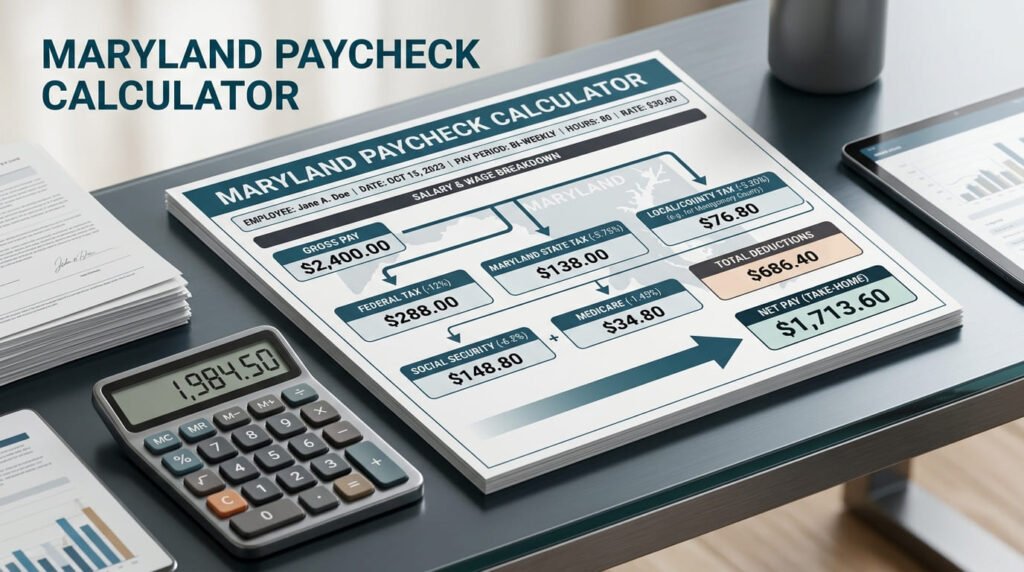
Take a single filer earning $60,000 a year, paid every two weeks, living in Montgomery County, with one MW507 exemption and no deductions. Here is what the Maryland paycheck calculator shows for one paycheck:
| Line | Per paycheck | How it is worked out |
|---|---|---|
| Gross pay | $2,307.69 | $60,000 divided by 26 |
| Federal income tax | $193.08 | ($60,000 less $8,600) on the 2026 single table is $5,020 a year |
| Social Security | $143.08 | 6.2% of gross |
| Medicare | $33.46 | 1.45% of gross |
| Maryland state tax | $97.56 | 4.75% of $53,400 ($60,000 less $3,400 less $3,200) |
| Montgomery County tax | $65.72 | 3.20% of the same $53,400 |
| Take-home pay | $1,774.79 | About $46,145 a year |
This person keeps about 76.9% of their gross pay. Maryland’s two taxes together take $163.28 a paycheck, which is more than Social Security.
Paid hourly instead, at $25 an hour for 40 hours a week and paid weekly, the same person grosses $1,000 and takes home $776.01 a week.
Pre-tax deductions that raise your take-home pay
Money you put into a traditional 401(k) or 403(b) comes out before income tax. So a contribution costs you less than its face value.
In the example above, a 5% contribution takes $115.38 from each paycheck. Take-home pay only drops by $92.36, to $1,682.43. The other $23.02 is income tax you no longer pay: $13.85 federal, $5.48 Maryland and $3.69 county. Social Security and Medicare stay the same, because 401(k) money still counts for FICA.
Health, dental and vision premiums, HSA contributions and FSA contributions usually go through a Section 125 plan. Those lower FICA too, so they save even more. Enter them under Pre-tax benefits. If you are weighing a dental plan, our dental insurance cost estimator shows what a plan pays and what you pay.
Every dollar you save from take-home pay counts toward retirement. If you want to know when your savings could keep growing without new contributions, try the CoastFIRE calculator.
Why your paycheck may not match this estimate
If your pay stub shows a different number, one of these is usually the reason:
- An old form on file. A W-4 from before 2020 uses allowances, which this calculator does not model. Give your employer a 2026 W-4 and MW507 and the figures should line up.
- The wrong county. Your employer withholds for the county you gave them. If you moved and never updated it, your paycheck uses the old rate.
- Bonuses and commissions. Employers often withhold on extra pay at a flat rate, which is different from the regular method shown here.
- A benefit that is only partly pre-tax. Some plans take part of a premium after tax. Your pay stub lists which deductions come out before tax.
What the calculator assumes
- A full year at the same pay. This Maryland paycheck calculator estimates 2026 withholding on a full year at the pay you enter. A job that starts mid-year, a bonus or a raise changes the real figures.
- Social Security and extra Medicare are averaged. Real payroll stops Social Security once you pass $184,500 and starts the extra 0.9% Medicare once you pass $200,000. The calculator spreads both evenly across the year.
- Withholding, not your final tax. Your return uses the 2% to 4% brackets, the full standard deduction and your credits, so your refund or balance due can differ.
- Your county on December 31. Maryland charges the local rate for where you live at the end of the year. If you move, update your county with your employer.
- Section 125 benefits are fully pre-tax. Some plans treat part of a benefit as taxable. Check your pay stub.
Payday timing affects how many checks land in a month. The business days calculator counts working days between two dates, which helps when a payday falls on a holiday. Our Indiana paycheck calculator works the same way for Indiana’s flat state tax and 92 county rates. For a receipt, the reverse sales tax calculator works back to the price before tax.
What is changing: paid family leave in 2027
Maryland’s Family and Medical Leave Insurance program, known as FAMLI, has been delayed. The Maryland Department of Labor says payroll contributions are scheduled to start in January 2027, with benefits from January 2028. Until then, a Maryland paycheck has no FAMLI line. This calculator will add it when contributions begin.
Your salary never leaves your browser
The calculation runs in JavaScript on your own device. Your pay, county and deductions are never sent anywhere, never stored and never put in the page address. Close the tab and they are gone.
Frequently asked questions
How much of my paycheck goes to Maryland taxes?
Two Maryland taxes come out of every paycheck: state tax and a local tax for your county or Baltimore City. Employers withhold state tax at 4.75% on most wages, rising to 6.5% on very high incomes, and the local rate runs from 2.25% to 3.30%. On a $60,000 salary paid every two weeks in Montgomery County, that is $97.56 of state tax and $65.72 of county tax each paycheck.
What is the local income tax rate in my Maryland county for 2026?
Most jurisdictions charge 3.20%, including Baltimore City, Baltimore County, Montgomery, Prince George's and Howard. Dorchester and Kent charge the most at 3.30%. Worcester charges the least at 2.25%, and Talbot charges 2.40%. Anne Arundel and Frederick use income-based schedules instead of one rate. The table on this page lists all 24.
Why is Frederick County taxed differently from Anne Arundel?
Both have income-based local rates, but they work in opposite ways. Anne Arundel is marginal: 2.70% on the first $50,000 of taxable income and 2.94% only on the part above it. Frederick applies one rate to your whole taxable income, picked by your income tier. So a single Frederick filer with $25,001 of taxable income pays 2.75% on every dollar, about $125 more than at $25,000.
Do I pay Maryland tax if I live in Pennsylvania, Virginia, West Virginia or DC?
Residents of DC, Virginia and West Virginia pay no Maryland income tax on their wages if they file Form MW507 with their employer and do not keep a home in Maryland for 183 days or more. Pennsylvania residents skip Maryland state tax but still pay the local tax of the Maryland county where they work, unless they live in York or Adams County or a town that does not tax Maryland residents.
How many exemptions should I claim on Form MW507?
Most people claim one for themselves, one for a spouse if filing jointly, and one for each dependent. Your employer treats each exemption as $3,200. If your income is over $100,000 ($150,000 if you file jointly or as head of household), each exemption is worth less, and the MW507 worksheet shows how many you can claim.
Does Maryland take out paid family leave (FAMLI) in 2026?
No. Maryland's Family and Medical Leave Insurance program has been delayed. The Maryland Department of Labor says payroll contributions are scheduled to begin in January 2027, with benefits from January 2028. A 2026 Maryland paycheck has no FAMLI deduction.
Last updated: September 25, 2026