
Roth IRA vs Traditional IRA: Which Is Better for You?
Tax now or tax later. The two tax rates decide it, worked out with real numbers, then the 2026 income limits, early access and required withdrawals.
The difference between a Roth IRA and a traditional IRA is when you pay tax. A traditional IRA can give you a deduction now, and you pay income tax when you take the money out. A Roth IRA gives no deduction now, and qualified withdrawals are tax-free. If your tax rate in retirement will be higher than today, the Roth usually comes out ahead; if it will be lower, the traditional IRA does; at the same rate, they end up equal. The rules around them, income limits, required withdrawals and early access, often decide it before the tax rates do.
Roth IRA vs traditional IRA at a glance (2026)
| Roth IRA | Traditional IRA | |
|---|---|---|
| Tax break | Later: qualified withdrawals are tax-free | Now: contributions may be deductible |
| Contribution limit | $7,500 in total across both, $8,600 at 50 or older | |
| Income limit to contribute | Yes: phases out from $153,000 single, $242,000 joint | No |
| Income limit to deduct | Not applicable | Only if you or your spouse have a workplace plan |
| Withdrawing what you put in | Any time, tax and penalty free | Taxed, plus 10% before 59.5 unless an exception applies |
| Withdrawing earnings | Tax-free at 59.5 after five years | Taxed as income |
| Required minimum distributions | None for the original owner | From age 73 |
| Deadline for 2026 | The filing deadline, 15 April 2027 | |
The tax difference, with numbers
Ignore the rules for a moment and only the two tax rates matter: yours today and yours when you withdraw. For the same take-home cost:
- A Roth takes after-tax money and never taxes it again.
- A traditional IRA takes pre-tax money, so each take-home dollar buys more contribution, then taxes everything at the end.
A 30-year-old putting $7,500 a year into a Roth from now to 65, at 7% a year, builds about $1,109,351 from those contributions, all tax-free. The same take-home cost in a deductible traditional IRA gives:
| Tax rate now | Tax rate in retirement | Traditional IRA after tax | Better choice |
|---|---|---|---|
| 12% | 22% | $983,288 | Roth |
| 22% | 22% | $1,109,351 | Equal |
| 24% | 12% | $1,284,512 | Traditional |
These assume the traditional deduction is available and that the tax saving is invested too. The Roth IRA calculator runs the same comparison with your own rates, age and return.
Which way will your tax rate go?
Nobody knows future tax law, but a few signs point one way or the other:
- Early in your career, in a low bracket: your rate is more likely to rise. That favours the Roth.
- At your peak earnings, in a high bracket: you may well drop to a lower bracket in retirement. That favours the traditional IRA.
- A large traditional 401(k) already: required withdrawals plus Social Security can keep your retirement income, and rate, high. That favours adding Roth money.
- Planning to retire to a state without income tax: the traditional deduction now may be worth more than the Roth’s tax-free withdrawals later.
Who can contribute, and who can deduct
Roth IRA: the income limit is on contributing
| Filing status (2026) | Full Roth contribution below | No Roth contribution at or above |
|---|---|---|
| Single, head of household | $153,000 | $168,000 |
| Married filing jointly | $242,000 | $252,000 |
| Married filing separately, lived together | $0 | $10,000 |
Above the range, the backdoor Roth IRA is the usual way in.
Traditional IRA: the income limit is on deducting
Anyone with taxable compensation can contribute to a traditional IRA. Whether you can deduct it depends on whether you, or your spouse, are covered by a retirement plan at work:
| Situation (2026) | Deduction phases out between |
|---|---|
| Single, covered by a workplace plan | $81,000 and $91,000 |
| Married filing jointly, you’re covered | $129,000 and $149,000 |
| Married filing jointly, only your spouse is covered | $242,000 and $252,000 |
| Married filing separately, covered | $0 and $10,000 |
| Neither of you covered | No limit: fully deductible |
If you can’t deduct it, a traditional IRA loses its main advantage. For most people in that position, a Roth (directly or through the backdoor) is the better home for the money.
Getting the money out
- Roth contributions are always yours. You can take out what you put in at any time, with no tax or penalty, because you’ve already paid tax on it. That makes a Roth a reasonable backstop for emergencies, although money taken out can’t be put back later beyond the annual limit.
- Roth earnings are tax-free once you’re 59.5 and five years have passed since 1 January of the year of your first Roth contribution.
- Traditional IRA withdrawals are taxed as income. Before 59.5 there’s usually a 10% penalty too, with exceptions such as a first home (up to $10,000), higher education costs and some medical expenses.
- Required minimum distributions start at 73 for a traditional IRA (75 for people born in 1960 or later). A Roth IRA has none during the owner’s lifetime, so the money can keep growing tax-free.
Can you have both?
Yes. The $7,500 limit ($8,600 at 50 or older) is shared, so you can split it however you like: $4,000 to a Roth and $3,500 to a traditional IRA, for example. Splitting is a reasonable answer when you’re unsure which way your tax rate will go. It gives you a pot of taxable money and a pot of tax-free money to draw from in retirement, which lets you manage your taxable income year by year.
You can also convert traditional IRA money to a Roth later. You pay income tax on the amount converted that year, so conversions are often done in low-income years, such as between retiring and starting Social Security.
A quick way to decide
- Is your income above the Roth range? Use the backdoor, or a traditional IRA if you can deduct it.
- Can’t deduct a traditional contribution? Choose the Roth.
- Expect a higher tax rate in retirement, or want flexible access? Lean Roth.
- In a high bracket now and expect a lower one later? Lean traditional.
- Not sure? Split the contribution, and revisit it each year.
Frequently asked questions
Is a Roth IRA better than a traditional IRA?
Not always. A Roth is better if your tax rate in retirement will be higher than today, a traditional IRA if it will be lower. At the same rate, they come out the same. The Roth’s extra flexibility, no required withdrawals and access to contributions, often tips a close call.
Can I contribute to a Roth and a traditional IRA in the same year?
Yes, as long as the total stays within $7,500 for 2026, or $8,600 if you’re 50 or older.
What is the income limit for a traditional IRA?
There’s no income limit to contribute. The limit is on the deduction, and only applies if you or your spouse have a workplace retirement plan: for a single filer who’s covered, it phases out between $81,000 and $91,000 in 2026.
Do I pay tax when I withdraw from a Roth IRA?
Not on your contributions, ever. Not on earnings either, once you’re 59.5 and the five-year rule is met.
Sources
- IRS, Notice 2025-67 and news release IR-2025-111: 2026 IRA limits, catch-up, Roth phase-out and traditional IRA deduction ranges.
- IRS, Publication 590-A (contributions) and Publication 590-B (distributions, the five-year rule, early withdrawal exceptions and required minimum distributions).
- SECURE 2.0 Act of 2022: required minimum distribution age of 73, rising to 75.
- Figures in the tax comparison: our Roth IRA calculator, where each is asserted in its tests.
Checked 12 November 2026. This guide is general information, not tax or investment advice. Returns aren’t guaranteed and tax law can change.
Tools in this guide
All of them run in your browser. Nothing uploaded.
More guides
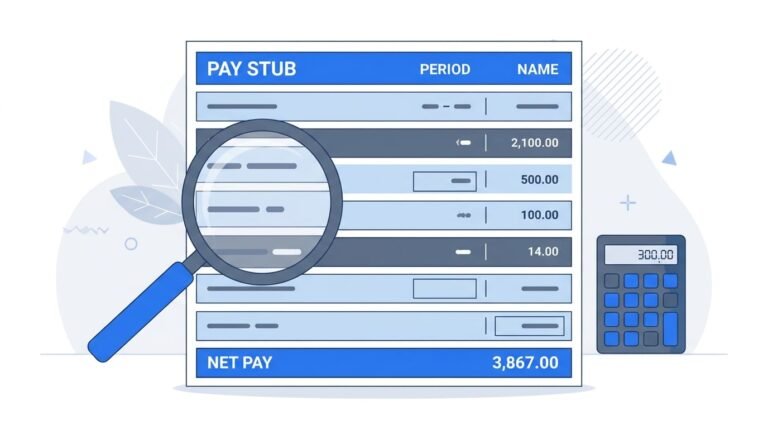
How to Read a Pay Stub, Line by Line
Gross pay, then pre-tax deductions, taxes and after-tax deductions, then net pay. A real stub explained line by line, the common codes, and how to check it.
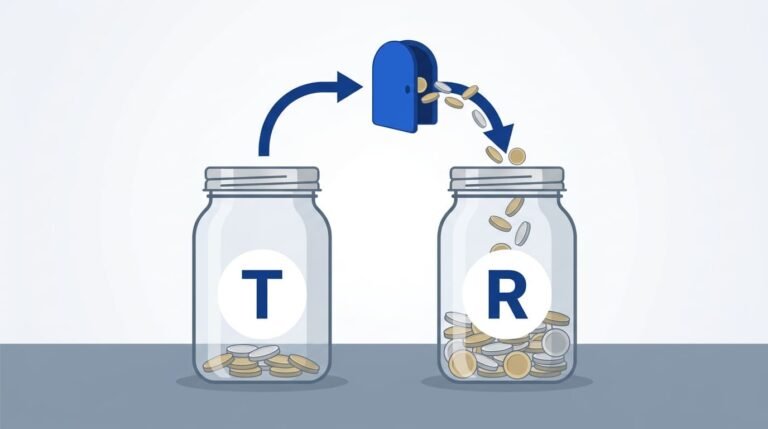
Backdoor Roth IRA: How It Works, Step by Step
Too much income for a Roth? Contribute to a traditional IRA without the deduction, then convert. The six steps, Form 8606, and the pro-rata rule with numbers.
Tool: Roth IRA Calculator
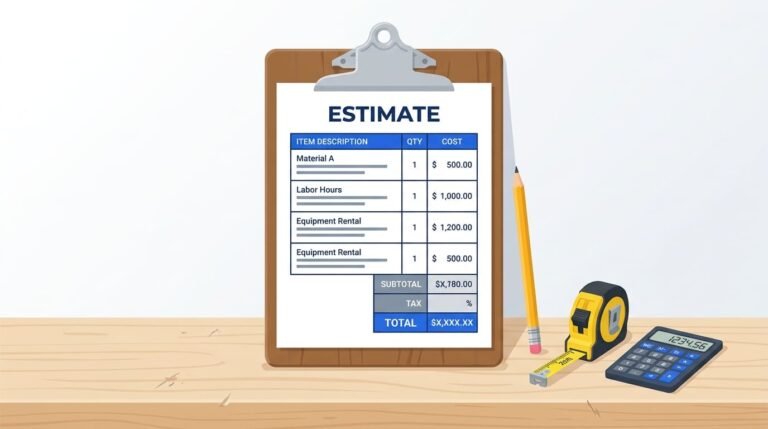
How to Write a Job Estimate (With a Worked Example)
Work out your costs, price from your margin, then write the estimate the customer sees: scope, priced lines, exclusions and terms. One job taken from numbers to page.
Last updated: November 12, 2026