
Fractional Excretion of Sodium (FENa): Formula and Meaning
The fractional excretion of sodium (FENa) helps tell prerenal kidney injury from tubular damage. Learn the formula, the cut-offs and when it misleads.
The fractional excretion of sodium, usually written FENa, is the percentage of the sodium filtered by the kidneys that ends up in the urine. Doctors use it when kidney function drops suddenly, to help tell whether the kidneys are short of blood flow or are damaged themselves. It takes one blood sample, one urine sample and a short formula. It also has a long list of situations where it misleads, and knowing those matters as much as knowing the cut-off.
This guide explains what the fractional excretion of sodium measures, how to calculate it, what the numbers suggest, how well the test really performs, and when to use something else.
This is an educational article, not medical advice. FENa is one clue among many. Decisions about a patient belong to the clinicians looking after them.
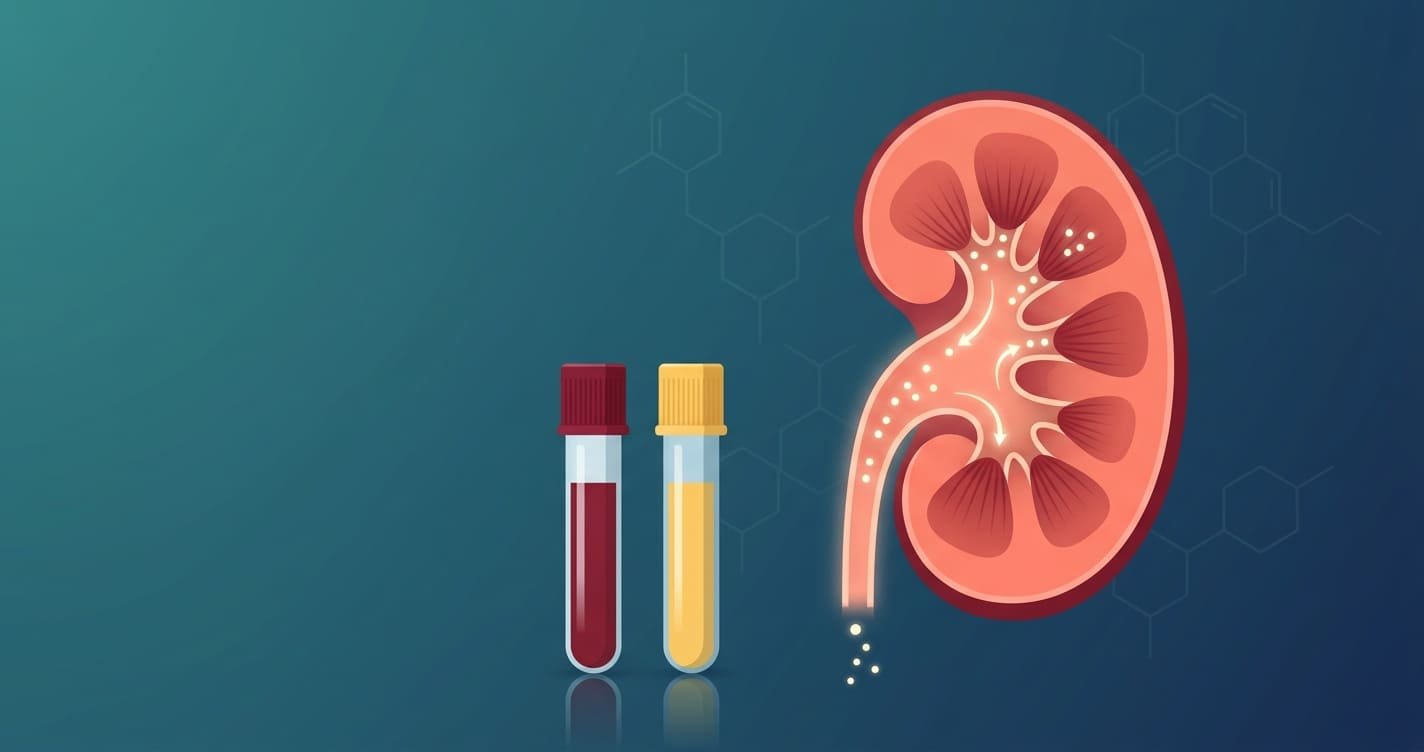
Fractional excretion of sodium at a glance
| Question | Short answer |
|---|---|
| What is it? | The share of filtered sodium that is excreted in the urine, as a percentage |
| What is it for? | Helping to separate prerenal acute kidney injury from acute tubular necrosis |
| What do you need? | Sodium and creatinine, in blood and in a spot urine sample taken at about the same time |
| Formula | (urine Na x serum creatinine) / (serum Na x urine creatinine) x 100 |
| Below 1% | A prerenal pattern: the kidneys are holding on to sodium |
| Above 1%, often above 3% | An intrinsic pattern such as acute tubular necrosis |
| Biggest pitfalls | Diuretics, chronic kidney disease, and using it in someone whose kidneys are working normally |
| Main alternative | Fractional excretion of urea (FEUrea), with a cut-off of 35% |
To run the numbers, use our FENa calculator. It also works out FEUrea and converts mixed creatinine units for you.
What is the fractional excretion of sodium?
Your kidneys filter a huge amount of sodium every day and then take nearly all of it back. A rough illustration: a healthy adult filters about 180 litres of plasma a day. At a sodium concentration of 140 mmol/L, that is about 25,000 mmol of sodium entering the kidney tubules. If that person eats and excretes about 150 mmol of sodium a day, only 0.6% of what was filtered leaves in the urine. The other 99.4% is reabsorbed.
That 0.6% is a fractional excretion of sodium. It answers one question: of the sodium the kidneys filtered, how much did they let go?
The idea becomes useful when the kidneys are under stress, because two common problems push the number in opposite directions:
- Too little blood reaching the kidneys. Healthy tubules respond by reabsorbing even more sodium, to hold on to fluid. FENa falls.
- Damage to the tubules. Injured tubules can’t reabsorb sodium properly. More escapes. FENa rises.
Where it fits: acute kidney injury
Acute kidney injury (AKI) means kidney function falls over hours to days. The widely used KDIGO definition is any one of: a rise in serum creatinine of 0.3 mg/dL or more within 48 hours, a rise to 1.5 times baseline or more within a week, or urine output below 0.5 mL/kg per hour for 6 hours.
The causes are traditionally sorted into three groups.
| Type | What’s wrong | Typical causes |
|---|---|---|
| Prerenal | The kidneys are intact but under-perfused | Dehydration, bleeding, vomiting and diarrhoea, heart failure, low blood pressure |
| Intrinsic | The kidney tissue itself is injured | Acute tubular necrosis (ATN) after prolonged low blood flow or a toxin, acute interstitial nephritis, glomerulonephritis |
| Postrenal | Urine can’t drain | Enlarged prostate, stones, tumours, a blocked catheter |
The distinction matters because the treatments differ. Prerenal AKI often reverses once blood flow is restored. In established ATN, more fluid may not help and can do harm. The fractional excretion of sodium was designed to help separate those first two groups. It says nothing useful about a blockage. Imaging does that.
The fractional excretion of sodium formula
FENa (%) = (urine sodium x serum creatinine) / (serum sodium x urine creatinine) x 100
You need four values:
- Urine sodium (UNa) and serum sodium (SNa), in mmol/L or mEq/L, which are the same number for sodium.
- Urine creatinine (UCr) and serum creatinine (SCr), in the same unit as each other.
The blood and urine samples should be taken at about the same time. A random “spot” urine sample is enough. No 24-hour collection is needed.
Why creatinine is in the formula
Urine sodium alone is hard to read, because it depends on how concentrated the urine is. A dehydrated person makes small amounts of concentrated urine, which pushes every concentration up, sodium included.
Creatinine fixes that. It’s filtered by the kidneys and barely reabsorbed, so the ratio of urine creatinine to serum creatinine tracks how much water the tubules have removed. Dividing by it cancels the effect of urine concentration. What remains is the fraction of filtered sodium that was excreted, whatever the urine volume.
Worked examples
Example 1: a prerenal pattern
A patient with two days of vomiting has a serum sodium of 140 mmol/L and a serum creatinine of 2.0 mg/dL. A spot urine shows sodium 15 mmol/L and creatinine 120 mg/dL.
FENa = (15 x 2.0) / (140 x 120) x 100 = 30 / 16,800 x 100 = 0.18%
That is well below 1%. The kidneys are conserving sodium hard, which fits under-perfusion.
Example 2: an intrinsic pattern
A patient recovering from septic shock has a serum sodium of 138 mmol/L and a serum creatinine of 3.0 mg/dL. Urine sodium is 60 mmol/L and urine creatinine is 40 mg/dL.
FENa = (60 x 3.0) / (138 x 40) x 100 = 180 / 5,520 x 100 = 3.26%
That is above 3%. The tubules are letting sodium through, which fits tubular injury.
Example 3: the unit mistake
Outside the US, labs often report serum creatinine in µmol/L and urine creatinine in mmol/L. Suppose serum creatinine is 180 µmol/L, urine creatinine is 9 mmol/L, urine sodium is 20 and serum sodium is 140.
- Typed as given: (20 x 180) / (140 x 9) x 100 = 286%. Impossible.
- With urine creatinine converted to 9,000 µmol/L: (20 x 180) / (140 x 9,000) x 100 = 0.29%.
The error is a factor of exactly 1,000. Our FENa calculator lets you pick the unit for each creatinine value, converts them, and flags a urine creatinine that is lower than the serum value, because that almost always means a unit slip.
How to interpret the fractional excretion of sodium
| FENa | Pattern | What is happening in the kidney |
|---|---|---|
| Below 1% | Prerenal | Tubules are working and reabsorbing sodium avidly in response to low perfusion |
| 1% to about 3% | Indeterminate, leaning intrinsic | Could be either. Many sources treat anything above 1% as intrinsic; the original study used 3% |
| Above 3% | Intrinsic, typically ATN | Damaged tubules can’t reabsorb sodium |
Two points are easy to miss.
The cut-offs only apply in AKI. As the arithmetic above showed, a healthy person eating a normal diet has a fractional excretion of sodium below 1% all the time. A low FENa in someone with normal kidney function isn’t a finding. It’s ordinary physiology.
The cut-offs were built for a narrow group. The test was first described in patients who were passing very little urine, had no chronic kidney disease, and hadn’t been given diuretics. Outside that group it gets less reliable, sometimes much less.
Where the numbers come from, and how good the test is
- 1976. Carlos Espinel described the FENa test in JAMA, in patients in the oliguric phase of acute renal failure. Those with prerenal azotemia had a FENa below 1. Those with acute tubular necrosis had a FENa above 3. A later review notes that the study included just 17 carefully selected patients.
- 2002. Carvounis and colleagues compared FENa and FEUrea in 102 episodes of acute renal failure. Of the prerenal patients not on diuretics, 92% had a FENa below 1%. Of the prerenal patients who had received diuretics, only 48% did.
- 2022. A systematic review and meta-analysis in the Clinical Journal of the American Society of Nephrology pooled 19 studies with 1,287 patients.
That meta-analysis is the best summary of how the test performs. It looked at FENa as a way to tell intrinsic from prerenal AKI.
| Group studied | Studies (patients) | Sensitivity | Specificity |
|---|---|---|---|
| Oliguric, no chronic kidney disease, no diuretics | 8 (264) | 95% | 91% |
| All studies using a 1% threshold | 15 (872) | 90% | 82% |
| Studies that included chronic kidney disease or diuretics | 6 (511) | 83% | 66% |
| Patients on diuretics | 5 (238) | 80% | 54% |
Read down the last column. In the patients the test was designed for, it works well. In patients on diuretics, a specificity of 54% is close to a coin toss. The authors concluded that the fractional excretion of sodium has a limited role in patients with chronic kidney disease or on diuretics, and is most valuable when the patient is oliguric.
When the fractional excretion of sodium misleads
A 2022 debate article in Kidney360 grouped the confounders by the direction of the error. This table follows that grouping.
| FENa looks high, but the cause is prerenal | FENa looks low, but there is tubular injury |
|---|---|
| Diuretics | AKI with liver failure or heart failure |
| Chronic kidney disease | Recent iodinated contrast |
| Sodium-containing IV fluid given before the sample | Early sepsis-associated AKI |
| Glucose in the urine, including from SGLT2 inhibitors | Pigment injury from myoglobin (rhabdomyolysis) or haemoglobin |
| Bicarbonate in the urine, as with vomiting | |
| Salt-wasting conditions such as Bartter or Gitelman syndrome |
Two further causes of a low urine sodium that aren’t prerenal AKI at all: acute glomerulonephritis and acute urinary obstruction.
Some of these deserve a sentence each.
- Diuretics work by making the kidneys excrete sodium. A dehydrated patient on furosemide can have a FENa of 2% or 3% with perfectly healthy tubules.
- Chronic kidney disease leaves fewer working nephrons, and scarred tubules can’t reabsorb sodium maximally. The baseline FENa is higher before any acute illness.
- IV fluids are often started before anyone sends urine chemistry. A saline load raises urine sodium by itself.
- Heart failure and liver failure make the kidneys retain sodium intensely. A low FENa is expected and doesn’t rule out tubular injury on top.
There’s a deeper limit as well. A low value tells you the tubules are retaining sodium. It doesn’t tell you why. Dehydration, cardiorenal syndrome and hepatorenal syndrome all give a low FENa, and their treatments are very different. Fluids help the first and can harm the other two.
FENa vs FEUrea
The fractional excretion of urea uses the same idea with urea in place of sodium:
FEUrea (%) = (urine urea x serum creatinine) / (serum urea x urine creatinine) x 100
Urea is reabsorbed mostly in the early part of the tubule, by passive forces that loop diuretics affect less. So FEUrea was proposed for patients who have had diuretics.
| FENa | FEUrea | |
|---|---|---|
| Prerenal pattern | Below 1% | 35% or below |
| Intrinsic pattern | Above 1%, often above 3% | Above 35% |
| On diuretics | Unreliable | Holds up better |
| Extra tests needed | None beyond sodium and creatinine | Serum urea (BUN) and urine urea |
In the Carvounis study, FEUrea averaged about 28% in untreated prerenal patients, 25% in prerenal patients on diuretics, and 59% in ATN. Of the prerenal patients on diuretics, 89% had a FEUrea below 35%, against 48% with a FENa below 1%.
FEUrea isn’t a perfect fix. The Kidney360 authors point out that urea transporters sit all along the nephron, that loop diuretics have been shown to shift FEUrea in decompensated heart failure, and that sepsis may alter urea handling too. Treat it as a better option after diuretics, not a guarantee.
Other clues doctors use alongside it
No one should diagnose the cause of AKI from a single ratio. These are commonly taught supporting findings. The exact figures vary between sources.
| Test | Prerenal pattern | ATN pattern |
|---|---|---|
| Urine sodium | Low, often below 20 mmol/L | Higher, often above 40 mmol/L |
| Urine osmolality | Concentrated, often above 500 mOsm/kg | Close to plasma, often below 350 mOsm/kg |
| BUN to creatinine ratio (mg/dL) | Often above 20 to 1 | Often 10 to 15 to 1 |
| Urine microscopy | Bland, or hyaline casts | Granular “muddy brown” casts, tubular epithelial cells |
| Response to fluids | Creatinine improves within a day or two | Little or no improvement |
Urine microscopy deserves a special mention. The Kidney360 authors argue that muddy brown casts and tubular cells under the microscope outperform both FENa and FEUrea for diagnosing ATN, and predict recovery better. History and examination come first: fluid losses, blood pressure, drugs, recent contrast, and whether the bladder is emptying.
How the test is done
- A blood sample for sodium and creatinine. Add urea (BUN) if FEUrea is wanted.
- A spot urine sample at about the same time, for sodium and creatinine. Add urine urea for FEUrea.
- Timing around diuretics. If the patient has had a diuretic, the result is hard to trust. One family medicine reference suggests waiting 6 to 8 hours after the last dose, or using FEUrea instead. Our date duration calculator will count the hours between two times if you’re working from a drug chart.
- Before fluids if possible. A urine sample taken after a litre of saline tells you about the saline.
- Calculate with the four values in matching units.
For patients, there’s little to it: a blood draw and a urine sample. MedlinePlus notes that you would normally eat your usual diet with a normal amount of salt beforehand unless told otherwise.
Special groups
- Newborns. Newborn kidneys, especially in premature babies, excrete a larger share of filtered sodium. Adult cut-offs don’t apply, and neonatal units use higher thresholds that depend on gestational age.
- Older adults. The formula is the same at any age. Chronic kidney disease and diuretic use are both more common, so the caveats above bite more often. If you need a patient’s exact age from a date of birth, the age calculator gives it in years, months and days.
- People with chronic kidney disease. A FENa of 2% may be their normal. A single value means less than a change from their baseline.
Common mistakes
- Mixing creatinine units. Serum in µmol/L and urine in mmol/L gives a result 1,000 times too high.
- Swapping serum and urine values. Urine creatinine should be far higher than serum creatinine. If it isn’t, check the entry.
- Using samples taken hours apart. The formula assumes the blood and urine describe the same moment.
- Reading it in someone without AKI. A low value is normal in health.
- Ignoring diuretics. Check the drug chart before you check the number.
- Treating “below 1%” as “give fluids”. Heart failure and liver failure also give a low FENa.
- Treating the result as a diagnosis. It describes what the tubules are doing with sodium right now. That’s all.
Is the fractional excretion of sodium still worth calculating?
Nephrologists disagree, and Kidney360 published the argument as a formal debate in 2022. One side holds that FENa and FEUrea remain useful, cheap and fast when applied to the right patients. The other holds that the list of exceptions is now so long that the tests “perform better in the classroom than the clinic”, and that urine microscopy is a better use of time.
A fair reading of both sides:
- It’s most informative in an oliguric patient with no chronic kidney disease who hasn’t had diuretics or much IV fluid.
- A clearly low or clearly high value in that setting adds real weight to the clinical picture.
- A value near 1%, or any value in a patient with confounders, shouldn’t change anyone’s mind.
- It never replaces the history, the examination, the urine sediment and, where needed, imaging.
Fractional excretion of sodium FAQs
1. What is the fractional excretion of sodium in simple terms?
It’s the percentage of the sodium filtered by your kidneys that leaves in your urine. Healthy kidneys reabsorb about 99% of filtered sodium, so the figure is normally small.
2. What is a normal FENa?
In a healthy person on an ordinary diet it’s usually below 1%, and it rises and falls with salt intake. The diagnostic cut-offs are only meant for people with acute kidney injury.
3. What does a FENa of less than 1% mean?
In someone with acute kidney injury, it suggests a prerenal cause: the kidneys are under-perfused but the tubules still work and are conserving sodium. It’s also seen in heart failure, liver failure, contrast injury, early sepsis and rhabdomyolysis, so it doesn’t prove dehydration.
4. What does a FENa above 2% or 3% mean?
In acute kidney injury, it suggests intrinsic damage such as acute tubular necrosis, because injured tubules can’t reabsorb sodium. Diuretics, chronic kidney disease and IV saline can also raise it without any tubular injury.
5. How do you calculate the fractional excretion of sodium?
Multiply urine sodium by serum creatinine. Divide by serum sodium multiplied by urine creatinine. Multiply by 100. Both creatinine values must be in the same unit. A FENa calculator does it in a second and checks the units.
6. Does FENa work if the patient is on diuretics?
Poorly. Diuretics increase sodium excretion, so FENa can be high in a prerenal state. In a pooled analysis, specificity fell to 54% in patients on diuretics. The fractional excretion of urea is the usual alternative.
7. What is the difference between FENa and FEUrea?
They use the same formula with a different solute. FEUrea uses urea instead of sodium and has a cut-off of 35%. Loop diuretics affect it less, so it’s preferred after diuretics, though it has its own limits.
8. Do I need a 24-hour urine collection?
No. A single spot urine sample and a blood sample taken at about the same time are enough.
9. Can FENa diagnose kidney failure?
No. It doesn’t detect kidney injury or measure kidney function. It’s used after acute kidney injury has been identified, as one clue to its cause.
10. Is the fractional excretion of sodium reliable in chronic kidney disease?
Less so. Scarred tubules can’t reabsorb sodium maximally, so the baseline value is higher and the 1% cut-off loses its meaning. Pooled specificity fell to 66% in studies that included chronic kidney disease or diuretics.
Run your numbers
If you have the four lab values, the FENa calculator will give you the fractional excretion of sodium, add FEUrea if you enter urea, and catch a unit mismatch before it reaches the notes. It runs in your browser and stores nothing. You can find the rest of our calculators on the all tools page and more explainers in our guides.
Sources
- Espinel CH. The FENa test. Use in the differential diagnosis of acute renal failure. JAMA. 1976;236(6):579 to 581.
- Carvounis CP, Nisar S, Guro-Razuman S. Significance of the fractional excretion of urea in the differential diagnosis of acute renal failure. Kidney International. 2002;62(6):2223 to 2229.
- Abdelhafez M, Nayfeh T, Atieh A, et al. Diagnostic performance of fractional excretion of sodium for the differential diagnosis of acute kidney injury: a systematic review and meta-analysis. Clinical Journal of the American Society of Nephrology. 2022;17(6):785 to 797.
- Aron AW, Amatruda JG. Fractional excretion of sodium and urea are useful tools in the evaluation of AKI: CON. Kidney360. 2023;4(6):e728 to e730. The paired PRO article is in the same issue.
- KDIGO Clinical Practice Guideline for Acute Kidney Injury. Kidney International Supplements. 2012;2(1).
- MedlinePlus Medical Encyclopedia. Fractional excretion of sodium.
- Family Practice Notebook. Fractional excretion of sodium (timing after diuretics).
Tools in this guide
FENa Calculator
Fractional excretion of sodium and urea from lab values, in any mix of units.
Date Duration Calculator
Count the days between two dates, both ways.
Age Calculator
Work out an age, or the gap between two people.
All of them run in your browser. Nothing uploaded.
More guides

Home & Garden
How Much Sand Do I Need? Pavers, Sandboxes and More
How much sand do I need? Get the formula, the weight of dry and wet sand, and worked examples for paver bases, sandboxes, pool bases and fish tanks.
Tool: Sand Calculator

Home & Garden
How Much Rock Do I Need? Formula, Charts and Examples
How much rock do I need? Square feet x inches / 324 gives cubic yards, then multiply by tons per yard. Charts, depths, coverage and worked examples.
Tool: Rock Calculator

Home & Garden
How Much Salt to Add to Pool Water: Formula and Charts
Work out how much salt to add to pool water with one formula. Charts by pool size, targets for Hayward, Jandy and Pentair, and how to fix too much.
Tool: Pool Salt Calculator
Last updated: October 4, 2026